


In 1718 BC the assassination attempt against Amenemhat I of the 12th Dynasty failed to kill him. But he was severely wounded. He raised his son, Senusret I, to the throne with him as high king. Senusret conducted the investigation of the palace staff which led to the baker and the butler being incarcerated until their guilt or innocence could be determined.
Two years later, the Pharaoh started having bad dreams, and the butler finally remembered Joseph who had been able to interpret his dream accurately. In his third year, Senusret summoned Joseph from the prison to hear his dream. And the rest is history. Because of Joseph’s accurate interpretation of the dream, he was elevated to the right hand of the high king, and indeed he became a king himself. He is found in the 13th Dynasty as Yufni, which is probably a mispelling of Yusef.
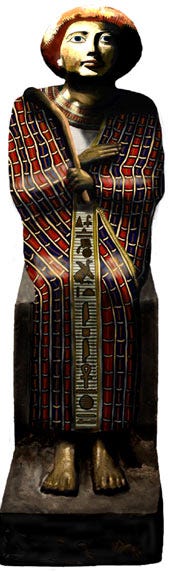
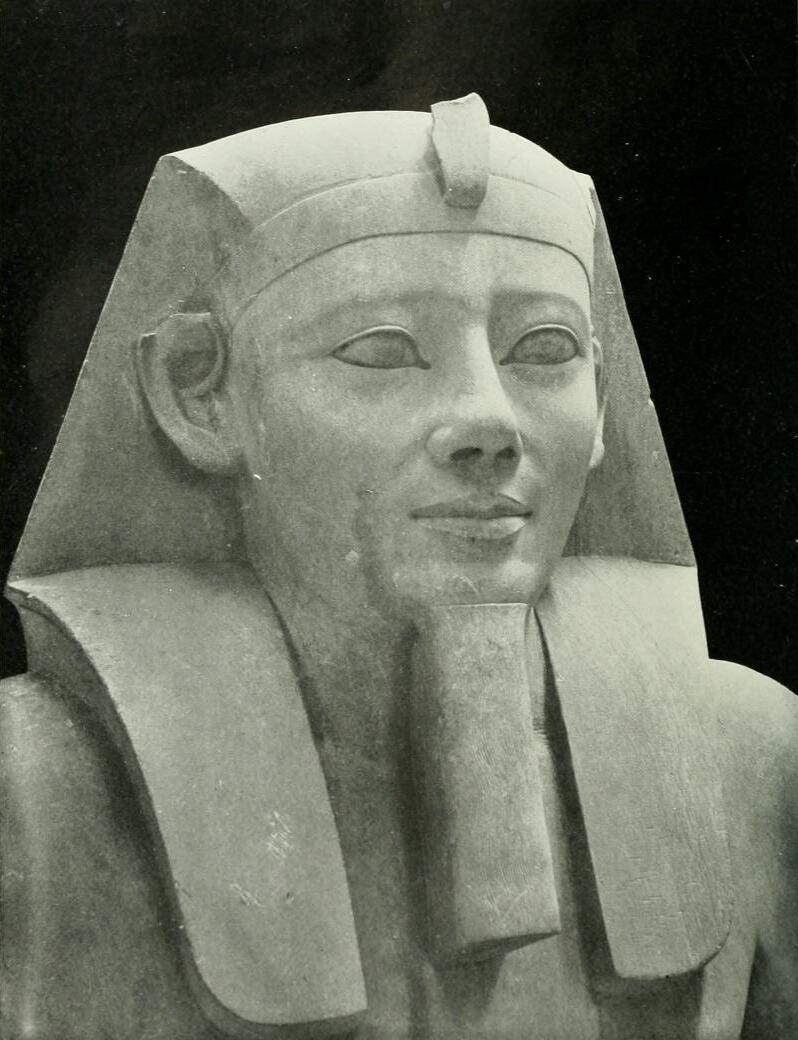
Senusret, also called Sesostris, was quite serious about honoring the God who had revealed the coming famine to him. Breasted writes:
In his third year Sesostris I called together his court, and announced his purpose of erecting a temple to the [Re] at Heliopolis.
Re was the Egyptian equivalent of El, the God of light who created the world.
Senusret left the following account in a leather scroll that survived to the present day.
Thir month of the first seasons, day ___, under
the majesty of the King of Upper and Lower Egypt, Kheperkere,
Son of Re, Sesosris (I), triumphant.
Living forever and ever.
When the king appeared in the double crown,
Occurred in the sitting in the audience-hall,
One took counsel with his suite,
The companions of the court,
The princes of the Place of ___.
One commanded, while they heard,
One took counsel, while making them reveal:
“Behold, my majesty is exacting a work,
And taking thought on an excellent matter.
For the future I will make a monument,
And set up an abiding stela for Harakhte [a title of Re].
He begat me to do that which he did,
To execute that which He commanded to do.
He appointed me shepherd of this land.
He recognized him who should defend it,
He hath given to me that which he protects,
And that which the eye, that is in him, illuminates.
…
He appointed me lord of the two halves,
As a child, before the swaddling clothes were loosed for me,
He appointed me lord of mankind,
…
My beauty shall be remembered in his house,
My name is the pyramidion, and my name is the lake,
Eternity is that excellent thing which I have made;
The king dies not, who is mentioned by reason of his achievements.
…
It is excellent to look to the morrow,
And with excellent things to the coming time.
After waxing long about his own greatness, Senusret mentioned his new companion, who was Joseph.
The king himself said
to the wearer of the royal seal, the sole companion,
The overseer of the double White House,
The privy counselor of ——
It is thy counsel which shall cause the work to be done.
Of which my majesty desires, that it should be;
Thou are the commander belonging to it,
Who shall do, according to that which is in my heart,
….. vigilance,
That it may come to pass without laxity,
That all the work …..
..
I have commanded those who work,
To do according as thou shalt exact.
The primary work of Joseph during the seven years of plenty was to direct the Egyptian workforce to dig a canal from the Nile River to the Fayum depression, which enabled the creation of Lake Moeris. The Fayum depression was a dry sandy dustbowl which had gone dry during the Ice Age. When Joseph connected the Nile to the Fayum Basin, Lake Moeris was created. The lake acted as a reservoir for the scarce water of the Nile during the dry season, and also extended the season of irrigation using the waters of the Nile.
In the ninth year of Senusret, which was the sixth year of plenty, the lake was completed. His servant, Meri, writes:
I wa a zealous servant, great in character, amiable in love. My lord sent me wiht a commission, because I was so very zealous, to execute for him an eternal dwelling, great in name thatn Rosa, and more excellent in appaointments than any place, the excellent district of the gods. Its columns pierced heaven; the lake which was dug, it reached the river; the gates towering heavenward, were of limestone of Troja. Osiris, First of the Westerners, rejoiced over all the monuments of my lord; I myself rejoiced, and my heart was glad at that which I had executed.
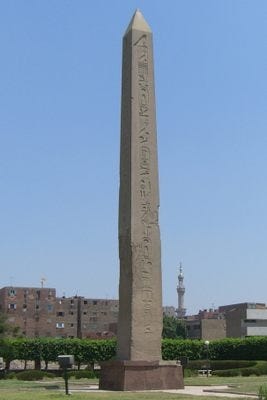
Senusret wished to honor the God who sent him the dream and the interpreter that saved Egypt and make him fabulously wealthy. To do so he erected an obelisk in Heliopolis, the city of the priests of On. He had given Joseph as his wife the woman, Asenath, daughter of Potiphera, the High Priest of Re at On. That obelisk is the oldest Egyptian obelisk still standing in its original position today. The God who sent the dream preserved the obelisk down to AD 2025. Despite wars, invasions, and gunpowder, the obelisk honoring the true God still stands today in its original position, 3,740 years after it was first erected.
Fascinating. Are you relying on Egyptian sources? Query, who was the Pharaoh in Egypt 400 years later?
Incredible! Thank you so much for sharing this one with us!