


In my work with Darrell K. White on the Chronological Framework of Ancient History, we discovered something important. What we discovered is something that archaeologists have been searching for without finding for two centuries. What we found is the holy grail of Christian archaeology. We found King David and King Solomon, and Ish-bosheth to boot! They are right there in the ancient records, the diplomatic correspondence from the cities of Mari, Yamhad, and Qatna.
The reason that archaeologists have completely missed David and Solomon is that they believe King David lived in the Iron Age, when he actually lived in the culture they call the Middle Bronze Age. In other words they are not digging deep enough.
Another reason is that some of the kings of Israel used throne names, different from their given names used in Scripture. That was a common practice in the ancient near east. When a man was crowned king, he took on a new name, his throne name, which was used in all diplomatic correspondence.
Once you repair the broken chronology of the Ancient Near East by bringing it down by about 800 years, the Israelite Kings pop out of the woodwork. Their neighbors to the North referred to them as Benyamina (the Benjamites) and the Kings of Qatna, meaning the City of Dan. There are even several letters from Saul’s whiney son, Ish-bosheth to his daughter’s father in law, and uncle in law.
Royal Servant of the God El
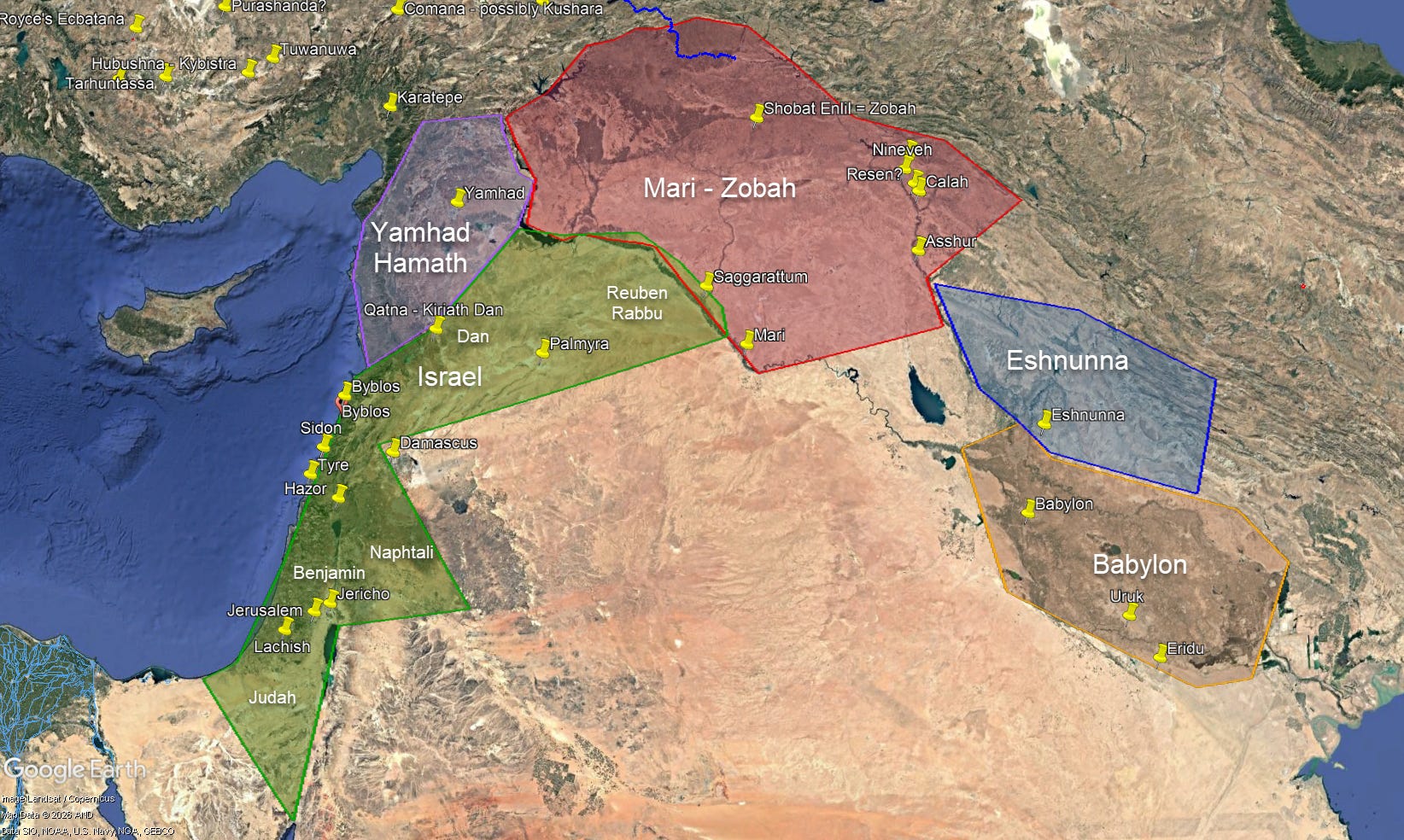
According to Jewish tradition, King Solomon had at least seven names. We have identified him as the fourth king of the City of Qatana, which we belive to have been a contraction for “Kiriath Dan.” (Many cities in that region used the Kar-Ka-Qa prefix meaning “city of” like Carchemish, Kanesh, QarQar, etc.) King David did not capture Jerusalem until 1048 BC. For the first four hundred years that Israel was in the Promised Land, the two biggest cities were Dan and Hazor. Therefore, during the United Monarchy of Israel, their neighbors viewed King Saul, King Ishbosheth, King David, and King Solomon as the kings of Qatna, meaning, “King of Dan.”
The Netherlands today has two names. The country is called The Netherlands, but the people who live in that country are called the Dutch. Israel was labeled in a similar manner by its neighbors. When speaking of Israel’s kings, they were called Kings of Qatna. But, when speaking of the people of Israel, they were called Benyamina - the Benjamites. The reason is that Israel’s first king, Saul, went by the title “Saul of Benjamin.” About two dozen of the diplomatic letters from Mari, a city on the Euphrates River, discuss the problems with the tribes of Benyamina, and also mention the chiefs of various tribes of the Benyamina, including the Rabbu, which were probably the tribe of Reuben.
Rezon of Damascus, Ruler of Syria, Enemy of Solomon
The Book of Kings tells us that God raised up three enemies for Solomon because of his apostasy with foreign women. The third of these was a king named Rezon, son of Eliada, who fled from his master, Hadadezer.
And God raised up another adversary against him, Rezon the son of Eliadah, who had fled from his lord, Hadadezer king of Zobah. So he gathered men to him and became captain over a band of raiders, when David killed those of Zobah. And they went to Damascus and dwelt there, and reigned in Damascus. He was an adversary of Israel all the days of Solomon (besides the trouble that Hadad caused); and he abhorred Israel, and reigned over Syria. (1 Kings 11:23-25)
This king Rezon son of Eliada, who fled from Hadadezer the King of Zobah can be identified as Zimri-Lim the King of Mari, whose father’s name was Yahdun-Lim. In the local dialect, they used Lim instead of the Hebrew El. El Yahdun = Eliada. He was one of the Kings of Zobah that King Saul fought early in his reign.
So Saul established his sovereignty over Israel, and fought against all his enemies on every side, against Moab, against the people of Ammon, against Edom, against the kings of Zobah, and against the Philistines. Wherever he turned, he harassed them. (1 Samuel 14:47)
In Yahdun-Lîm’s royal “Disc Inscription” (RIME 4, E4.6.8.1) he recorded that he defeated three Yaminite Kings near Tuttul on the Euphrates, establishing control of the city of Saggaratum. This probably occurred in the final two years of King Saul’s reign while Israel was distracted with the Philistine war that took the lives of Saul and Jonathan.
David fought a seven year war with Ishbosheth. Ishbosheth contracted a marriage alliance with Yasmah-Adad, King of Mari, in his first year as king after Saul’s death. Hadadezer, the father of Yasmah-Adad, supplied Ishbosheth with troops to fight David’s “rebellion”. However, Ishbosheth was ultimately murdered by his own men. Then David moved the capital and the Tabernacle to Jerusalem in 1048 BC.
Shortly after 1048 BC, King David made his first campaign against Hadadezer, who had conquered the city of Asshur in 1053 BC and taken the title Shamshi Adad IV.
David also defeated Hadadezer the son of Rehob, king of Zobah, as he went to recover his territory at the River Euphrates. David took from him one thousand chariots, seven hundred horsemen, and twenty thousand foot soldiers. Also David hamstrung all the chariot horses, except that he spared enough of them for one hundred chariots.
When the Syrians of Damascus came to help Hadadezer king of Zobah, David killed twenty-two thousand of the Syrians. Then David put garrisons in Syria of Damascus; and the Syrians became David’s servants, and brought tribute. So the Lord preserved David wherever he went. (1 Samuel 8:3-6)
The territory along the Euphrates that David “went to recover” was the territory along the Euphrates between Tuttul and Saggaratum that had been taken by Yahdun-Lim about ten years earlier. This gave Israel a “port” on the Euphrates River that allowed downstream trade with Babylon and upstream trade with Anatolia.
About ten years later, Yahdun-Lim was killed by Shamshi Adad (also known as Hadadezer), who conquered the City of Mari in 1038 BC and placed his own son, Yasmah-Adad on the throne there. When Shamshi Adad killed Yahdun-Lim, the son of the dead king, Zimri-Lim fled to the King of Yamahad (Hamath), whose name was Yarim-Lim. Yarim-Lim was the man named Joram whose father had sent him to King David with gifts in the year David conquered Jerusalem.
When Toi king of Hamath heard that David had defeated all the army of Hadadezer, then Toi sent Joram his son to King David, to greet him and bless him, because he had fought against Hadadezer and defeated him (for Hadadezer had been at war with Toi); and Joram brought with him articles of silver, articles of gold, and articles of bronze. King David also dedicated these to the Lord, along with the silver and gold that he had dedicated from all the nations which he had subdued— from Syria, from Moab, from the people of Ammon, from the Philistines, from Amalek, and from the spoil of Hadadezer the son of Rehob, king of Zobah.
Yarim-Lim of Hamath had given his daughter in marriage to Zimri-Lim. When Hadadezer (Shamshi-Adad) died in 1020 BC, Zimri Lim came back from Hamath. His return to Mari coincided with the final tumultuous years in Israel caused by David’s sin with Bathsheba. Zimri-Lim boasted in his first two years of reign, while David was still alive, of having defeated the Yaminites along the Euphrates.
Zimri-Lim aka Rezon, Solomon’s Enemy
After retaking Mari, and defeating the Israelite tribe of Rueben along the Euphrates River, Zimri Lim (Rezon) turned the city of Mari into a wonder of the ancient world. He built a palace with 251 rooms. Other kings of the region asked to come visit him just so they could see his amazing palace!
However, Rezon was a sharp dealer and a snake. He wrote the following letter to Solomon. (Solomon used the throne name Amut-pi-El, which means “Royal Servant of the Most High God.”) Here is the letter from Rezon (Zimri-Lim) to Solomon:
Tell Amut-pi-El, so says Zimri-Lim, your brother.
(About) your messenger that you have sent to Ešnunna and about whom have written me as follows, “Assign protectors for him to take him safely to Ešnunna.” This is what you wrote me. I have confined your messenger by me. As the adage has it [5 lines missing], “. . . you would be sending this man . . . into the fire.” He [the king of Ešnunna] has thoroughly intimidated those messengers of Yarim-Lim who came here, by saying, “Why did he not give me the urnu-wood that I asked of him?” He treated them as must not be done. For this reason, I have kept your messenger and have promptly sent you a full report. Now then, send me a full report whatever your decision as suits your consultation. Until an answer to my letter reaches me, I am keeping your messenger with me. Another matter: You are invited to the “cadavers of Dagan” (pagrāʾum) sacrifices and those for Ištar. Come.
Solomon knew that Zimri-Lim was his enemy. Solomon was obviously trying to establish good relations with the King of Eshnunna, a kingdom to the far east, just East of Babylon. That is why Solomon sent his messengers there. But Zimri-Lim detained his messengers with the excuse that the King of Eshnunna had been mean to the messengers of another kingdom recently.
It appears that Zimri-Lim was stirring up trouble and trying to prevent communication between Solomon and the King of Eshnunna. The trade route to Eshnunna from Israel required traveling down the Euphrates River. Zimri-Lim’s city of Mari was the only place with clean water and supplies along a long stretch of the river as it passed through the desert.

Here is Solomon’s reply to Zimri-Lim:
You wrote me the following about the messenger I sent to the king of Ešnunna, “I have kept him with me; your previous messenger was put to death. Should we cast into the fire this one as well?” This is what you wrote.
What have I done to the king of Ešnunna and how did I offend him? What have I taken from him? Following your suggestion, I conferred with my servants: his mission is fine. If he is to be kept alive, let him be kept alive. But if he is to be put to death, let him be put to death. He would be offering himself for his land and kinfolk. Let any other king who would send his messenger to Ešnunna learn from my example. As for you, send your messenger along with mine to lead him safely to Ešnunna. By these acts, I shall experience you as brother and friend.
Solomon’s answer is very smooth. While he obviously must suspect that Zimri-Lim was up to no good, Solomon charitably speaks to him as if his intentions are good. He says, if the King of Eshnunna treats messengers this way, other kings will learn not to trade or send messengers to him. But, Solomon still calls upon Zimri-Lim to send his own messenger along with Solomon’s to lead him safely to Eshnunna through Mariote territory.
Solomon’s conclusion, “by these acts, I shall experience you as brother and friend” is a classic example of encouraging people to be their best by assuming the best of them and asking them to take concrete action to show their good intentions.
Sadly, only one letter from Solomon has been preserved. We do not know what exactly caused the relationship between Solomon and Zimri-Lim to deteriorate, but we do know the eventual outcome.
Solomon and Hammurabi Carved Up the Kingdom of Zobah
Rezon (Zimri Lim) made plenty of enemies with his double dealing. While none of their correspondence has been preserved, it appears that Solomon made an alliance of sorts with Hammurabi of Babylon. In 998 BC, Hammurabi captured the city of Mari with its enormous palace. His men spent two years hauling away all the treasure and carefully cataloguing all of Zimri-Lim’s diplomatic correspondence (to learn which of the neighboring kings had been loyal and who had betrayed Hammurabi). In 996 BC, Hammurabi ordered his men to destroy the city of Mari. It was never rebuilt. The palace archives lay undisturbed in the dirt until they were rediscovered by French archaeologist André Parrot in 1933.
The year after Hammurabi’s men destroyed Mari, the Bible records what Solomon did.
It came to pass at the end of twenty years, when Solomon had built the house of the Lord and his own house, that the cities which Hiram had given to Solomon, Solomon built them; and he settled the children of Israel there. And Solomon went to Hamath Zobah and seized it. He also built Tadmor in the wilderness, and all the storage cities which he built in Hamath. He built Upper Beth Horon and Lower Beth Horon, fortified cities with walls, gates, and bars, also Baalath and all the storage cities that Solomon had, and all the chariot cities and the cities of the cavalry, and all that Solomon desired to build in Jerusalem, in Lebanon, and in all the land of his dominion.
Apparently, Hammurabi and Solomon had arranged to split Zimri-Lim’s kingdom into two parts. Hammurabi took the East, and Solomon took the West. The kingdom of Yamhad had been King David’s ally. But Yarim-Lim had died and his son, also named Hammurabi, had become allied with Rezon (Zimri-Lim). Solomon went up in his 20th year, 995 BC, and conquered both Yamhad (Hamath), and went as far as Shubat-Enlil, the city of Zobah, which had been Shamshi-Adad’s capital. After Solomon destroyed Shubat-Enlil it was never rebuilt. Today the mound is called Tell Leilan, near the city of Nisibit.
Source
Jack M. Sasson. 2015 From the Mari Archives - An Anthology of Old Babylonian Letters. Winona Lake, Indiana: Eisenbrauns.
From page: 171-173
I remember back when I was in college and David and Solomon and company were treated as baseless myth. Now here we are reading all of these guys’ casual correspondences with their contemporaries. Pretty darn cool haha