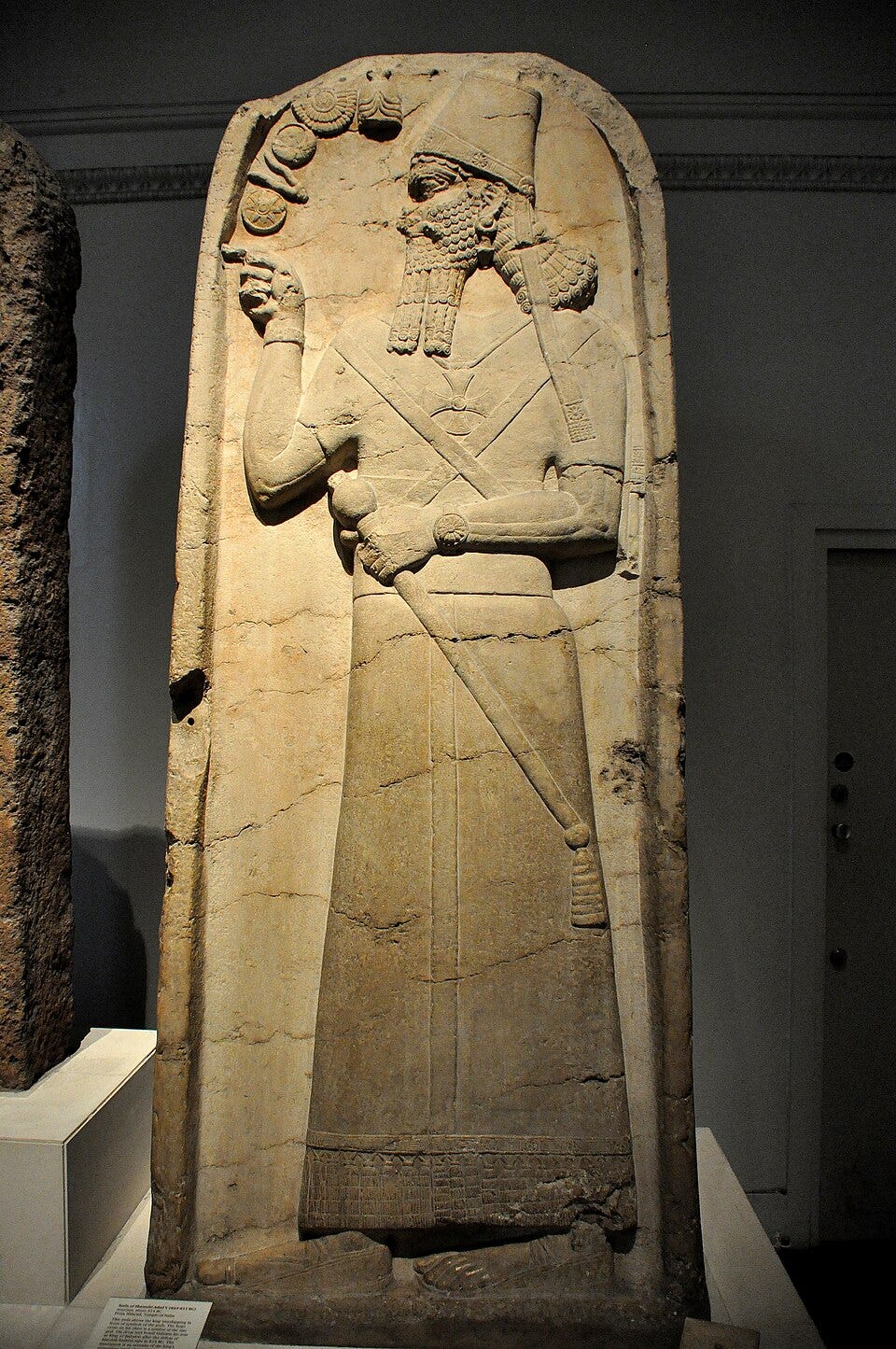
Current biblical scholarship at most seminaries and other Christian academic institutions is based in unbelief. They do not believe that the named authors of Biblical books such as Moses, Jonah, or James actually wrote the books attributed to them. They do not believe that prophets predicted events before they happened. They attribute the authorship of prophetic books to much later post exilic Jewish pseudo-historians writing history as prophecy, or in the case of James, later followers.
My viewpoint in historical analysis begins with full faith in the truth and accuracy of the Bible as the revealed Word of God to mankind. When historians begins with faith, it is amazing what we can find that the skeptical historians and scholars completely miss.
The book of Jonah poses an enigma to historians because Jonah was sent to the City of Nineveh where there was a King of Nineveh in a period of time that most scholars assume there was only a King of Assyria, the nation within which Nineveh lay.
Current biblical scholarship does not identify Jonah’s king of Nineveh with certainty, because Jonah 3:6 gives only the unusual, anonymous title “king of Nineveh,” not “king of Assyria,” and no Assyrian inscription links a named king to Jonah or to a Ninevite repentance.
In the dominant critical view, that anonymity is one reason the story is treated chiefly as a later theological narrative rather than a datable report of an eighth-century mission; many scholars date the book itself to the Persian period, even if they conceded that its Jonah figure was borrowed from the prophet of 2 Kings 14:25. In that view, asking which Assyrian king received Jonah has no recoverable historical answer, because they view it as fiction. Even scholars who accept an eighth-century setting generally say the king’s exact identity cannot be established from the available evidence.
Among scholars and commentators who do seek a historical identification, the usual candidates are the eighth-century rulers Adad-nirari III (810–783 BCE), Shalmaneser IV (783–773 BCE), and, in some reconstructions, Ashur-dan III (772–755 BCE); these proposals assume Jonah’s Nineveh mission occurred during the reign of Jeroboam II and identify the “king of Nineveh” as an informal local description of the reigning king of Assyria. However, those attempts are based on Edwin Thiele’s chronology of the Divided Kingdom, which chops out 44 years of real history. Thiele’s chronology causes an offset of the Judean and Israelite kings against the kings of Assyria. That offset consistently leads scholars hunting for Jonah’s King of Nineveh into a ditch.
Scholars who actually believe the Bible is the true and accurate Word of God, and who reject Thiele’s chronology, have found far more convincing evidence that pinpoints Jonah’s mission to Nineveh to a specific year. Rather than finding Jonah’s King of Nineveh in the the 8th century, we have to go back another 32 years into the 9th century.
Why Scholars Don’t Know When Jonah Lived
The Bible tells us that Jonah the son of Amitai had prophecied that Jeroboam II would reconquer the lands lost to Hazael of Damascus.
[Jeroboam II] restored the territory of Israel from the entrance of Hamath to the Sea of the Arabah, according to the word of the Lord God of Israel, which He had spoken through His servant Jonah the son of Amittai, the prophet who was from Gath Hepher. (2 Kings 14:25)
Therefore, Jonah had to have lived during or before the reign of Jeroboam II. The question is when did Jeroboam II reign?
The chronology of the Divided Kingdom of Judah and Israel is a difficult problem to solve, because the two kingdoms used different methods of recording regnal years. In Jerusalem they used accession-years. That means if the old king died in the sixth month, that full year was credited to him. His successor, the new king, counted his first year as beginning on the next New Year’s Day. It was not just Jerusalem that used this system. Assyria, Babylon, and later Rome also used accession year dating. That matters when trying to decipher the identities of the 10 kings of Rome in the Book of Revelation.
The Northern Kingdom of Israel was created when Thutmose III of Egypt installed Jeroboam I as his puppet king in 971 BC. Consequently, the Northern Kingdom borrowed much of its religion and its royal bureacratic practice directly from Egypt. In Egypt the reigns of the kings were counted precisely in years, months, and days. Thus they counted the accession of the new king on the very day he was installed, and the death of the old king on the very day that he died.
The Northern Kingdom of Israel was syncretistic - they combined the religion and practice of Jehovah worship with the Egyptian culture that Jeroboam and his son Nadab had learned while they were in exile from Solomon in the court of Thutmose III. They borrowed the Egyptian method of counting a king’s reign, without the detail of the months and days. They simply rounded up to the year. Therefore, the reigns of the Kings of Israel recorded in the books of Kings and Chronicles consistently add an extra year for nearly every reign. The last year of the old king was also counted as the first year of the new king.
The result of this is that if we tally up the reigns of the Kings of Judah in Jerusalem from the death of Solomon until Athaliah’s coup, and then we talley up the Kings of Israel for the same period, we get about 3 extra years on the Israel side. If we account for the four-year coregency between Jehoram and his father Jehoshaphat (2 Kings 8:16), then the difference rises to 7 years.
Edwin Thiele attempted to solve that problem and harmonize the Biblical chronology with the accounts of Sennacherib and Shalmaneser III of Assyria. However, Thiele’s solution favored the Assyrian accounts over Scripture, and required deleting 44 years from the Divided Kingdom period in the Bible. Therefore, seminarians following Thiele assume that the reign of Jeroboam II, in whose time Jonah prophecied, was from 793 to 753 BC. In the Ussherian chronology of the Bible, confirmed by Floyd Nolan Jones, Jeroboam II reigned from 825 to 784 BC. That 32-year shift in the reign of Jeroboam II makes all the difference for finding the mysterious King of Nineveh named by Jonah!
The King of Nineveh: Ashur-Danin-Pal
Shalmaneser III (859-824 BC) was the first native king of Assyria to campaign to the Mediterranean Sea and conquer the countries of the Levant. He was the “helper” whom God sent in answer to the prayers of the Israelites.
So Jehoahaz pleaded with the Lord, and the Lord listened to him; for He saw the oppression of Israel, because the king of Syria oppressed them. Then the Lord gave Israel a deliverer, so that they escaped from under the hand of the Syrians; and the children of Israel dwelt in their tents as before. (2 Kings 13:4-5)
Shalmaneser II was the deliverer of Israel. During his 35-year reign he conquered the nations from Cilicia in the north all the way to Damascus, eventually defeating Israel’s enemy Hazael in 841 BC.
Shalmaneser had two sons, Ashur-danin-pal, and Shamshi Adad V. For reasons we do not know, Shalmaneser chose his younger son as his heir to the throne. The older son, Ashur-Danin-Pal rebelled against his father and brother in 826 BC, and the rebellion lasted about four years past his father’s death until he was finally defeated by his brother in 820 BC.
The Greek chroniclers said that the final emperor of Assyria was a man named Sardanapallus. Upon his defeat, Sardanapallus allegedly locked himself in the royal palace and burned it down upon himself and his family. The name Sardanapallus appears to be based on the name of Ashur-Danin-Pal. He was not the final king of Assyria, as the empire lasted another two centuries past his death. But he did rebel against his father and younger brother, and he does appear to have come to a violent end.
During his six-year rebellion, the city of Nineveh was the seat of the power of Ashur-Danin-Pal. Therefore, there was a period of six years in the history of Assyria from 826 to 820 BC, during which Nineveh had its own king who was not the King of Assyria.
Jonah’s Mission
When using the Ussher-Jones dates for the reign of Jeroboam I, we find that his reign began in 825 BC, in the second year of the Nineveh rebellion led by Ashur-Danin-Pal.
Now the word of the Lord came to Jonah the son of Amittai, saying, “Arise, go to Nineveh, that great city, and cry out against it; for their wickedness has come up before Me.” (Jonah 1:1-2)
Jonah instinctively knew that becoming a prophet and telling a city of foreigners that their ways offended the true and living God of the Universe was a good way to get killed. So he fled in the opposite direction on a ship going to Tarsus, in Spain.
We all know the story of how the storm came up, the captain threw Jonah overboard, and he was swallowed by a “great fish,” probably a whale. As it happens, there is only one species of whale with a throat large enough to swallow a human - the sperm whale.
Why the Ninevites Listened to Jonah and Repented
After three days Jonah was coughed up on the shore by the whale, and he repented and decided to complete the mission God had assigned to him. Little did Jonah know, his experience with the whale was preparing him for the mission.
The people of Nineveh worshipped a fish-man god named Oannes. According to the Babylonian priest, Berossus, Oannes was a fish-man who came out of the sea and taught humanity the arts of civilization. At night he would go back into the sea. Oannes was always depicted as wearing a fish over his back and a fish head over his head. The mitre of the Christian bishops still reflects this design to this day.
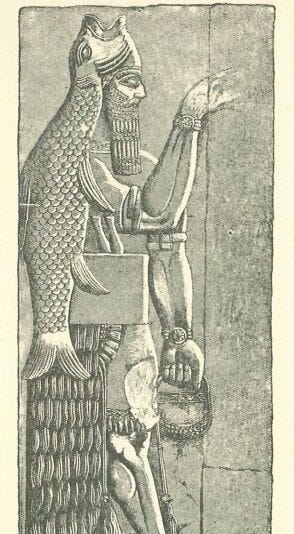
Oannes was probably a case of Euhemerism. Oannes was Noah, who survived the Flood and taught humanity the arts of law and civilization after the Flood. To the Assyrians, the names Oannes and Jonah were practically identical.
When a man named Jonah came to them with an account of having spent three days in the belly of a fish and urging them to repent, the Ninevites believed they were in the presence of Oannes. So they believed him and repented.
What did they repent of specifically? Most likely, in my view, Jonah came to Nineveh in the year 820 BC. Nineveh was in the sixth year of rebellion against the Assyrian Empire. Without Nineveh, Assyria would not be an empire. But God had plans for Assyria. It was the intention of Jehovah to use Assyria to chastise apostate Israel for their sins. That would not begin until the reign of the crown prince Tiglath Pileser, called Pul in the bible, in the reign of Menehem several decades later. Decades after Jonah, the prophet Isaiah stated God’s plans for Assyria:
“Woe to Assyria, the rod of My anger
And the staff in whose hand is My indignation.
I will send him against an ungodly nation,
And against the people of My wrath
I will give him charge,
To seize the spoil, to take the prey,
And to tread them down like the mire of the streets.”(Isaiah 10:5-6)
After six years of rebellion, the people of Nineveh finally submitted to the king of Assyria, Shamshi Adad V, in the year 820 BC. The Assyrian Empire was preserved to serve its purpose to chastise the rebellious and apostate people of Israel in the coming century.