


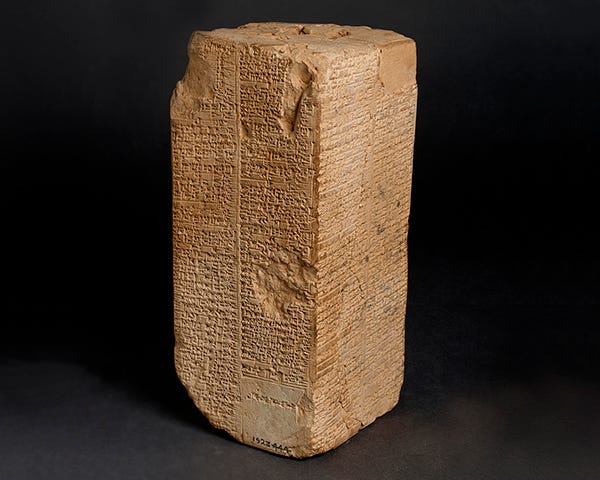
When archaeologists excavated the palace of the Assyrian Emperor Ashurbanipal in Nineveh, they found his library, which included about 30,000 cuneiform tablets. Among those tablets were found several copies of what is called the Sumerian King List (SKL). The Sumerian King List begins with the reigns of eight kings before the Flood with ridiculously long reigns, as high as 43,200 years, with a stated total of 385,200 years! The church historians, Syncellus and Eusebius, both reported that the Babylonian priest, Berossus, wrote that there were ten kings before the Flood whose reigns totalled 432,000 years. That sounds utterly delusional! However, in this post, I will present my hypothesis that the reigns in the SKL were multiplied by a mathematical cipher that can be reversed to find the true reigns.
The SKL continues:
Then the Flood swept over. After the Flood had swept over, and the kingship had descended from heaven, the kingship was in Kiš.
The list continues city by city, however the first two cities after the Flood, Kish and Uruk, have kings with reigns far longer than a human lifespan, but not nearly as long as the predeluvial kings. For example, the longest reign in the First Kish Dynasty was that of Etana the Shepherd who reigned for 1,500 years.
After the First Kish Dynasty, the SKL says:
Then Kiš was defeated and the kingship was taken to Eanna.
It then lists the kings of Uruk, the first five of whom again, have reigns of several centuries. After Gilgamesh, the fifth king, the reigns of the rest of the rulers in the list appear to be reasonable for normal human lifespans, except for the Kish dynasties II-IV, which continue to be “too high”.
Ancient Priests Loved to Play Games with Numbers
In several of my papers with Darrell White, we have pointed out that according to both Censorinus and Eusebius the pagan priests of several of the Mediterranean cultures would sometimes report days, months, bimestrals (two months), quadrimestrals (4 months) as “years” when giving their histories. We found several examples of this.
For example, Pliny the Elder reported that Greek astrologer, Epigenes (~270-200 BC), claimed the Babylonians had 720 or 720,000 years of astronomical observations on clay tiles. 720,000 year seems ridiculously too long, but 720 years is much shorter than Babylon was known to practice astronomy. However, if the 720,000 years are interpreted as days, they amount to 1,971 Julian years.
If Epigenes obtained this figure from a Babylonian source in the reign of Antiochus II Theos, whose accession to the throne was in 262 BC, then 1,971 years earlier was 2233 BC, the year for which we have found several other sources claiming the Tower of Babel was founded.
Another example of this practice was reported by Diodorus Siculus who said that the Egyptians claimed that Menes reigned 23,000 years before Alexander the Great conquered Egypt. Interpreted as months, the 23,000 units become 1,859.5 years. Alexander conquered Egypt in 332 BC. Adding 1,859.5 years comes to 2192 BC, the year reported as the Dispersion from Babel and the start of the reign of Ninus (Nimrod) by several sources.
Decrypting the Sumerian King List
My analysis of the Sumerian King List has revealed what appears to be a cipher. The scribe who composed the SKL multiplied the real reigns of the “gods” meaning ancestors before the Flood, and the rulers of Kish and early Uruk, by a consistent set of numbers, in order to exaggerate the reigns of the god-kings.
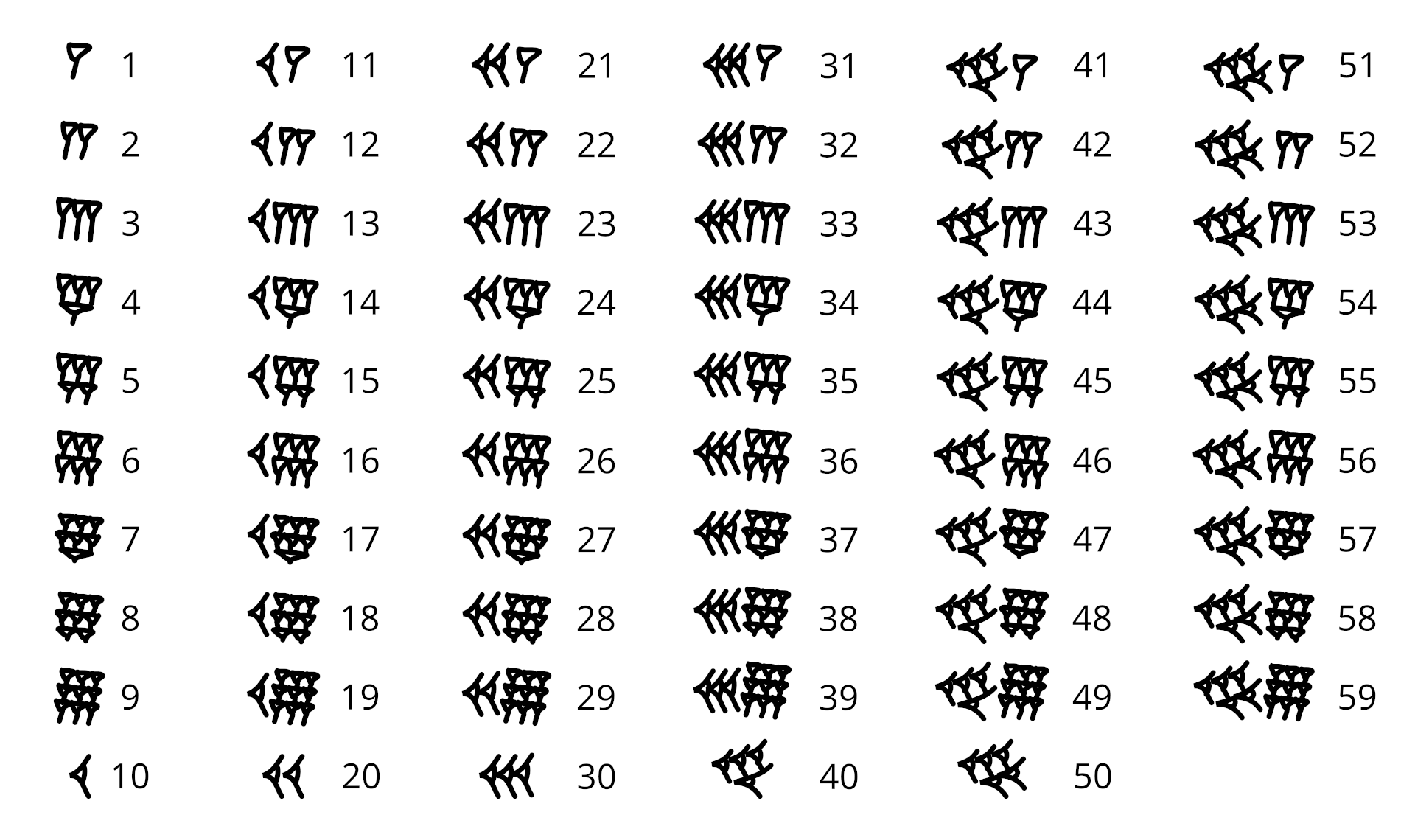
According to Eusebius and Syncellus, the Babylonian priest named Berossus wrote the history of Babylon as the book, Babylonaica, in Greek for the Seleucid Court. In that book, Berossus explained three Babylonian units of time as the saros (plural saroi) which was 3,600; the neros which was 600, and sessos which was 60.
The Babylonians used the sexagesimal numerical system where instead of each power of a number being written as 0-9, it was written as 0-60. In that system “10” means 60x60, or 3,600.
The Predeluvial Saros
While Berossus said the saros of 3,600 meant years, it could also have meant days. If we interpret the 432,000 years of predeluvial reigns reported by Berossus as being 120 x 3,600 days, the result is 120 decades of 360-day years, which is to say, 1,200 years of kings before the Flood. That is actually reasonably close to the time period recorded in Genesis that there were 1,656 years for the ten generations before the Flood from Adam to Noah.
Thus we might conclude that the 120 saroi in that context referred to decades. This multiplied the true solar years of the predeluvial rulers by a factor of 360.
The Deccans of Kish
After the Flood, the SKL continues with the rulers of Kish. We hypothesize that Cush originally named the city later called Babel after himself - Cush, or Kish. The reigns of Kish are inflated, but not nearly to the degree of the predeluvial kings. The first King of Kish is listed as Gišur, whom we identify as the Sumerian name for Cush.
By trial and error we came to the conclusion that the rulers of all four Kish dynasties in the SKL were given in deccans. A deccan is a period of 10 days. It was used in the Middle Kingdom of Egypt and also in China and Greece for astronomy. The constellations were divided into 36 deccans, using a 360-day year. This probably means the constellations were so divided into deccans by one of the patriarchs before the Flood, when the year was only 360 days. If my hypothesis is correct then the reigns of the Kings of Kish in the SKL are multiplied by 36.
The god-Kings of Uruk
The first five kings of Uruk in the SKL also have inflated reigns. They have the star-sign meaning “god” written next to their names. However, they do not all use the same cipher. The first King of Uruk, Meš-ki'ag-gašer, is also identifiable as Cush, as pointed out by David Rohl. This indicates that the Uruk Dynasty counted its origin from Babel also.
It appears to us that the SKL multiplies the reign of Meš-ki'ag-gašer by a factor of 6, so the time period counted is in bimestrals of two thirty-day months. His actual reign from the time the Earth was Divided, when Peleg was born, was 54 or 55 years until the Dispersion when the tongues were confused in 2192/2191 BC.
After Meš-ki'ag-gašer come three rulers: En-mer-kar (Nimrod), Dumuzi (Semiramis posing as a man), Gilgamesh (Ninyas Zames in Ctesias). (See the table below.) These three appears to be using the multiple of 3.33, or 20/6. This is not a natural cycle, but appears to be a numerical cipher chosen by the scribe to be less than six, but for some reason, greater than 3.
The Babylonians worshipped their first king, Cush, under the name Bel Marduk, the son of Utu (Ham). But they also considered Gilgamesh the last of the gods. So perhaps the scribe felt he should inflate the reigns of those three, but not as much as the first King, Bel Marduk, also known as Meš-ki’ag-gašer.
By the way, Meš-ki’ag-Gašer means “the youth has become mighty.” This applies well to Cush who usurped the kingship after Noah divided the earth as an inheritance among his sons and grandchildren, 101 years after the Flood in 2247 BC.
To Eber were born two sons: the name of one was Peleg, for in his days the earth was divided; and his brother’s name was Joktan.
— Genesis 10:25
So, we conclude that the first five kings of the Uruk Dynasty reigned about 282 years. After Gilgamesh the reign of the rest of the kings the SKL, excepting Kish and Hamazi, are given in regular years.
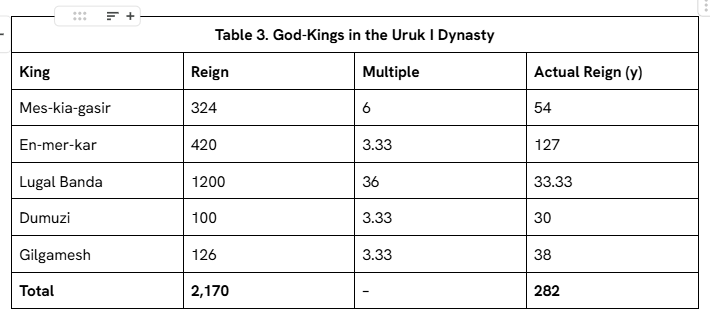
If my hypothesis is correct then the scribe who wrote the SKL used the following series of descending ciphers to inflate the reigns of the early kings. In all but one case the scribe steps down by one of the factors of 60: 10 or 6.
Predeluvial: 360X
Kish Dynasty (Babel): 36X
Cush: Meš-ki’ag-Gašer: 6X
Nimrod-Gilgamesh: 3.3 X
After Gilgamesh: 1X
The entry for Lugal Banda in the list is an outlier as his 1,200 year reign appears to use the deccan of Kish (36X).
Ok, so now we have a hypothesis, and we have a theory for why the scribe did it this way. But is my hypothesis falsifiable? Yes, it can be tested, which I will do next.
The Test Case: From Babel to Sargon of Akkad
I have identified the first rulers of both Kish and Uruk as references to the same person, Cush, the son of Ham, remembered as Belus, or Bel Marduk, and later worshipped as the god of Babylon.
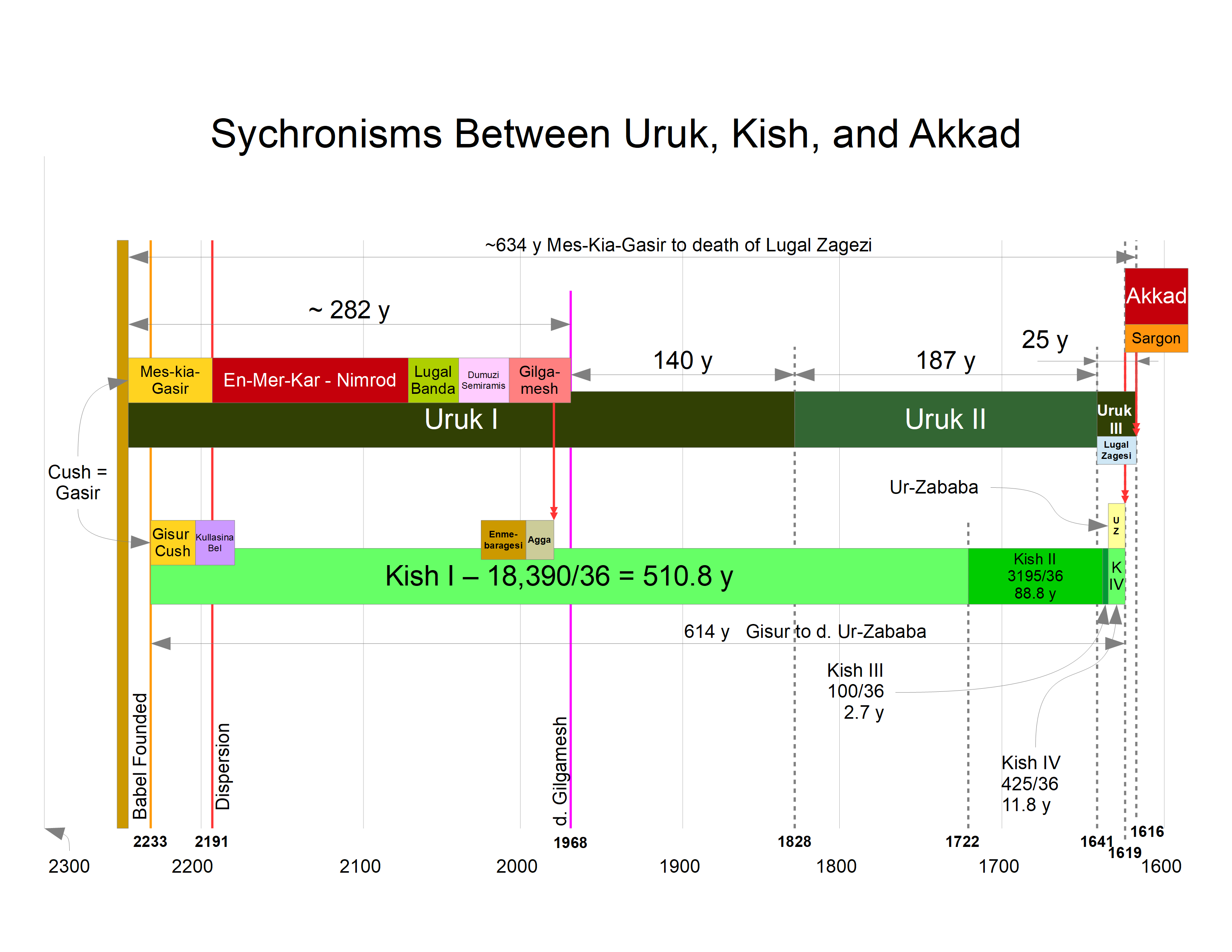
There is a synchronism between Ur Zababa, the second king of the fourth Kish Dynasty in the SKL, and Lugal Zagesi, the only king of the third Uruk Dynasty. They were both defeated by Sargon of Akkad, near the start of his reign. And Lugal Zagesi was the king of Uruk whom Sargon persuaded to help him defeat King Ur Zababa of Kish. If my hypothesis is correct, then the time from the founding of Babel to the defeats of those two kings should be about the same in both Kish (multiplied by 36X) and in Uruk (factoring for the inflated reigns of the first five god-kings). If the time between those two events does not come to roughly the same duration using the 36X multiple for the reigns of Kish, then my hypothesis will be proven false.
However, the first five reigns at Uruk are not precise, so we will count instead from the death of Gilgamesh, also known as Ninyas Zames, which several ancient chroniclers dated to 1968 BC.
Summing the reigns of SKL kings after Gilgamesh down to the death of Lugal Zagesi comes to 352 years. Subtracting from 1968 BC yields 1616 BC.
On the Kish side, if we sum the reigns of the Kings of Kish from Gisur to the death of Ur Zababa, and then divide by 36, the result is 614 years. Subtracting 614 from the year that Cush founded the Tower of Babel, 2233 BC, yields 1619 BC for the defeat of Ur Zababa by Sargon and Lugal Zagesi. That is only three years difference!
Even if we use my estimate of 282 years for the first five kings of Uruk, and use the year the Earth was Divided, when some chroniclers counted the start of the reign of Cush, then the result comes to 2247-634 = 1613 BC for the death of Lugal Zagesi. While that date is not as close to the start of Sargon of Akkad’s reign, it is still close enough to be plausible if someone does not like my date for Gilgamesh.
The results along the two paths give answers that are only three years apart. (see chart below) It is entirely reasonable that after helping defeat Ur Zababa and establishing himself as King of Akkad, it took three years for Sargon to consolidate his power and then attack and defeat his former ally, Lugal Zagesi.
Conclusion
This result confirms my hypothesis that the scribe who first composed the Sumerian King List was using a cipher to inflate the reigns of the early kings that Sumerian culture deified as gods. The Sumerian King List preserves real data, but inflates the reigns of the early kings using a consistent cipher that decreases by powers of 6 and 10, the two base factors of the Babylonian numeral system.
Interesting idea. 💡
I’m more looking at where the astronomical data appears in the numbers. But, I’ve put it on hold for the time being. I should get back to it in the next couple of years.
Fascinating deducing there. Can we build a unified timeline between Genesis, the Sumerians, the Egyptians, and any other ancient calendars yet?