


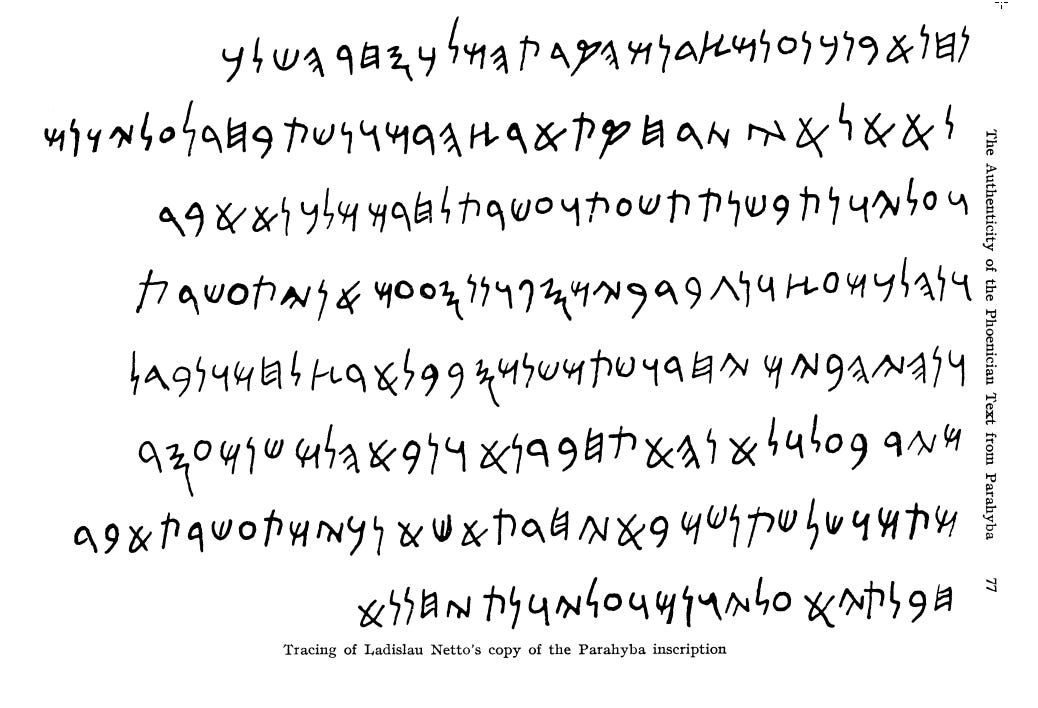
On September 11, 1872, Ladislau Netto, the Director of the Brazilian National Museum, Instituto Historico, received a letter with a copy of the above inscription, alleged to have been found on a stele in Paraíba, the easternmost state of Brazil. Little did Netto know, that inscription would ruin his career. Why? Because it claimed to be by the crew of a Phoenician ship that had been blown off course by a storm and beached in this unknown land (South America).
Cyrus Gordon tells how Netto was ruined by the inscription:
The inscription was assigned for publication to Ladislau Netto, Director of the Museu Nacional, in Rio de Janeiro. With no background in Semitics, he plunged into the study of Hebrew and Phoenician to translate it. The Emperor of Brazil, Dom Pedro II, albeit an amateur, enjoyed the reputation of being the nation’s only Semitist. Since Brazil had no one really competent in oriental studies, the Emperor and Netto turned to Renan for guidance. Renan, who had seen only a few phrases excerpted from the text (and grossly misinterpreted some of them!), condemned it as a fake in a letter to Dom Pedro written at Sèvres, Sept, 6, 1873 (Henriette Psichari, Œuvres complètes de Ernest Renan [Calmann-Iyévy; Paris], vol. 10, no. 452, p. 641 f.). From that moment Netto was doomed to ridicule which ruined his life. Half-crazed from public humiliation, he tried to extricate himself by publishing his Lettre à Monsieur Ernest Renan (Ivombaerta & Comp.; Rio de Janeiro 1885), in which he claims that ten years earlier (1875) he wrote letters to the five [all still unidentified!] people in Brazil capable of composing such a text in 1872.
Sadly, Netto’s career was ruined because he published a letter that gave evidence of something that was politically incorrect, then and now. It showed that the ancient Phoenicians had reached Brazil. Not only that, it showed that they sailed from the port of Ezion Geber which had been built by Solomon on the Red Sea for his Ophir expeditions.
That such a voyage was possible should not surprise us, for Herodotus records that Pharaoh Necho II (610-595 BC), after failing to make a canal from the Gulf of Suez to the Mediterranean, dispatched a fleet of ships from the Red Sea to circumnavigate Africa and that it took them three years to return by the Pillars of Heracles (Gibraltar) to Egypt.
A century after Netto’s humiliation, the esteemed linguistic scholar, Dr. Cyrus Gordon, re-examined the Paraiba Inscription, and concluded that it was authentic because it was written using Ugaritic Canaanite, which was unkown in 1872, and therefore could not have been written by a forger. Here is Gordon’s translation:
We are Sons of Canaan from Sidon, the city of the king.
Commerce has cast us on this distant shore, a land of mountains.
We set (= sacrificed) a youth for the exalted gods and goddesses
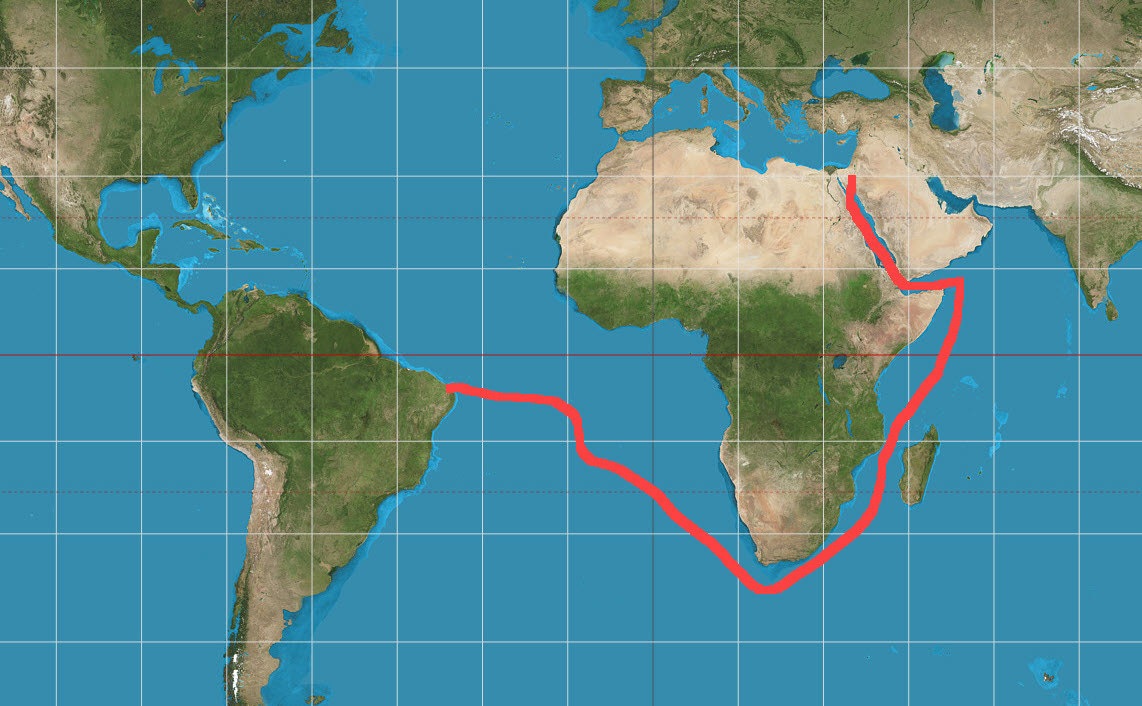
in the nineteenth year of Hiram, our mighty king. We embarked from Ezion-Geber into the Red Sea and voyaged with ten ships. We were at sea together for two years around the land belonging to Ham (= Africa) but were separated by a storm (lit., ‘from the hand of Baal’) and we were no longer with our companions. So we have come here, twelve men and three women, on a ... shore which I, The Admiral, control. But auspiciously may the exalted gods and goddesses favor us!
Figure 2 shows the route that the sailors took from Ezion Geber, the Israelite port on the Gulf of Aquaba, on the Red Sea.
Sponsored by King Hiram of Tyre, King Solomon’s ships sailed from the same port of Ezion Geber to the Land of Ophir, a journey that took three years round trip (1 Kings 9:26).
However, Gordon argues that the Hiram mentioned in the inscription was Hiram III (551-532 BC), who reigned as a judge over Tyre at the time that Cyrus the Persian conquered Babylon. Gordon comes to this conclusion because the inscription is written in Aramaic, and 2 Kings 16:6 says that Rezin of Damascus captured Elath (Ezion Geber) and the Syrians (Arameans) or Edomites lived there to the time that the Book of Kings was compiled, during the Exile in Babylon. Therefore the use of Aramaic dates the sailors who left the inscription to the reign of Ahaz (d. 627 BC) or later.
According to Josephus, Hiram III was the last king of Tyre. He was deposed in the fourteenth year of Cyrus the Great, which was (533 BC). Having lost their homeland to the Persians, the Phoenicians had every reason to migrate to their overseas colonies. The fact that the Paraiba inscription mentions the presence of women means that these sailors had brought their wives. They were colonists going in search of a new homeland. By the hand of fate, and the storm that separated them from the other nine ships, they found that homeland in Pairaiba Brazil circa 530 BC.
That was probably the coolest 5 minutes of my year haha right at the buzzer too. Thank you for your work!