

The Nakedness of Noah: Euhemerus Revisited - Part I
Matching the Pagan Pantheons with the Characters of the Bible

This is the first in a series of six articles that seek to identify Biblical characters in the myths and theogonies of the ancient nations of the world. In this post, I will examine how the pagans remembered the humiliation of Noah and the evidence that Nimrod built Nineveh.
Part II: Bible Characters in the Sumerian and Babylonian Pantheons
Part III: The Vengeance of Naamah
Part IV: The Return of the Nephilim
Part V: The Deeds of Gilgamesh
Part VI: Naamah Falls into the Pit She Dug for Noah
The Simple Proof from Noah to Nimrod
In this post, I intend to present basic proof that the Greeks and other nations of the Ancient Near East worshipped some of the Biblical patriarchs as their gods. My motive in looking at ancient accounts is to see if other cultures corroborate the Bible or shed more light on passages in the Bible.
Euhemerus was a Greek scholar in the third century before Christ who said that the Greek gods were merely deified ancestors. Since his time many others have made this case, most notably Alexander Hislop in the late nineteenth century. I believe that Euhemerus was correct, but do not approach this problem with the same agenda that Hislop had. By this, I mean that Hislop’s primary agenda was to make the case that the Pope and the practices of the Roman Catholic Church were descended from the polytheism of Nimrod. While some of Hislop’s connections may have been correct, I believe the reality was a bit more complex and nuanced than Hislop’s conclusion that Roman Catholicism is whitewashed paganism. It appears to me that Christ, in His choice of miracles, in some cases deliberately stepped into the mythology of the pagans of the ancient world, such that the pagans were able to easily view Christ as the fulfillment of some of their own deities.
I wish to approach the question of Euhemerism from a different direction than Hislop did. I am interested in ancient history. The connections between Nimrod and Christian practice are a related but quite different conversation that is beyond the scope of this series of papers.
I have identified two principles that are helpful when attempting to practice “Euhemerism.”
The first and most basic one is to identify actions that were unique to certain characters in the Bible that might identify them if spotted in ancient myths. Two such anchors enable me to make the identifications with confidence: Noah's nakedness exposed (Genesis 9:18-25), and Nimrod as the founder of Nineveh (Genesis 10:11).
The second principle is to look for the agreement of two or three ancient witnesses to confirm any fact (Deuteronomy 19:15).
The Exposure of Noah’s Nakedness
Genesis 9 relates the account:
18 Now the sons of Noah who went out of the ark were Shem, Ham, and Japheth. And Ham was the father of Canaan. 19 These three were the sons of Noah, and from these the whole earth was populated.
20 And Noah began to be a farmer, and he planted a vineyard. 21 Then he drank of the wine and was drunk, and became uncovered in his tent. 22 And Ham, the father of Canaan, saw the nakedness of his father, and told his two brothers outside. 23 But Shem and Japheth took a garment, laid it on both their shoulders, and went backward and covered the nakedness of their father. Their faces were [b]turned away, and they did not see their father’s nakedness.
24 So Noah awoke from his wine, and knew what his younger son had done to him. 25 Then he said:
“Cursed be Canaan;
A servant of servants
He shall be to his brethren.”
In Genesis chapter 9 we learned that:
Ham exposed the nakedness of Noah to his brothers in some way while Noah was sleeping off his wine.
Ham seemed to expect his brothers to support him.
Instead, Shem and Japheth covered their father’s nakedness.
Ham was the youngest son of Noah.
Ham received a curse upon his fourth son.
Shem and Japheth were blessed by Noah.
This event had several particulars that are unlikely to be randomly found in other historical tales. Namely, the youngest son humiliated his father in a way that required the exposure of his father’s nakedness and was in turn cursed by his father in relation to one of his own sons.
There are testimonies from four nations that seem to match this event. These come from the Jewish rabbis, the Greeks, the Phoenicians, and the Hittites.
From the Babylonian Talmud:
Sanhedrin 70a:18-19
Rav and Shmuel (disagreed). One said he [Ham] castrated him [Noah] and the other said he raped him. The one who claims that he castrated him explains in this way; that Ham thus prevented Noah from having a fourth son, which is why Ham’s fourth son, Canaan, is cursed. The other claims he raped him by a comparison of expressions. Here it is written, “And Ham, the father of Canaan saw the nakedness of his father” and there (Genesis 34:2) “And Shechem, son of Hamor the Hivite, chief of the country, saw her (Dina) and took her and lay with her by force.” [Translation by Rabbi Steven Greenberg]
The reason these two rabbis had this discussion is that the term “expose the nakedness of the father” is elsewhere used in the Torah to mean sexual relations, or sexual relations with a near relative, which is incest. It seems that merely being seen naked would not justify the curse that was placed on Ham’s youngest son, Canaan. Something more must have happened there which is being concealed by the words in the text itself. The author of this tablet of Genesis covered the nakedness of his father, Noah, by concealing the humiliating thing that was done to Noah. As will be seen later in this series, the author of Genesis also appears to have covered the nakedness of Naamah by not telling her full story either.
While the Babylonian Talmud dates to late Antiquity, it is fairly clear from the context that these are rabbis deducing more than their own textual tradition records, otherwise there would be no debate between them. However, Rav’s theory is supported by the accounts of the Hittites, Greeks, and Phoenicians.
In Hebrew "Noah" is written with only two letters, which can be latinised as “NU.” This root is found in the name of the chief god of nearly all the pantheons. (OurANOs, JaNUs, NEreus, ANUs, ANU, VishNU)
From the Hittites
First Alalus was king in heaven, who ruled 9 years. Then, Anu vanquishes Alalus1 and rules 9 years in heaven, Kumarbis is his right hand man. (ANET 120-125 Hittite myth, “Kingship in Heaven”, P. 120) (Emphasis added)
“In the ninth year Anu gave battle to Kumarbis and like Alalus, Kumarbis gave battle to Anu. When he could no longer withstand Kumarbis’ eyes, he Anu, struggled forth from the hands of Kumarbis. He fled, he Anu: like a bird he moved in the sky. After him rushed Kumarbis, seized him Anu, by his feet, and dragged him down from the sky. He (Kumarbis) bit his knees and his manhood went down into his inside. When it lodged there, and when Kumarbis had swallowed Anu’s manhood, he rejoiced and laughed. Anu turned back to him, to Kumarbis he began to speak: “Thou rejoicest over thine inside, because thou has swallowed my manhood. Rejoice not over thine inside! In thine inside I have planted a heavy burden. Firstly, I have impregnated thee with the noble Storm-god. Secondly, I have impregnated thee with the river Aranzahas, not to be endured. Thirdly, I have impregnated thee with the noble Tasmisus. Three dreadful gods have I planted in thy belly as seed. Thou shalt go and end by striking the rocks of thine own mountain with thy head!”
When Anu had finished speaking, he went up to heaven and hid himself. Out of his mouth spat Kumarbis the wise king. Out of his mouth he spat [ …] mixed with [...] That which Kumarbis spat out fell on Mount Kanzuras; [...] an awesome god therein.
The story goes on to tell how the Storm god and two other gods come out and overthrow Kumarbis.
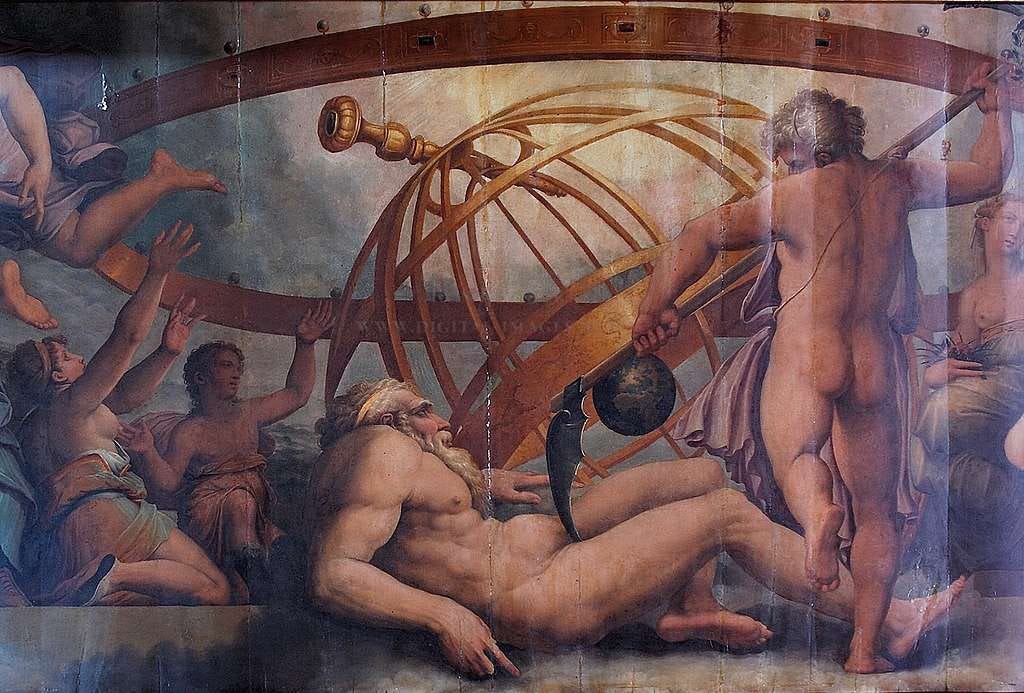
The Hittite myth names Anu as "Anus" (ah-noos) and specifies that the son "bit him in the knees" but the context makes it quite clear, it means he cut off his genitals. While it sounds crude and silly, the myth includes the same elements as the Bible story of Noah's nakedness. Kumarbis humiliates his father (by damaging his gonads), and his father curses him to be overthrown by his sons. Kum-arbis is identifiable by his actions as Ham, and his name Khum is also recognizable as Ham.
From the Phoenicians
Our third witness shines more light on this. From Sanchoniatho the Phoenician2: (emphasis added)
"In the thirty-second year of his power and reign, Ilus, who is Kronus, having laid an ambuscade for his father Ouranos in a certain place in the middle of the earth, and having gotten him into his hands, cuts off his private parts near fountains and rivers. There Ouranos was consecrated, and his spirit was separated, and the blood of his private parts dropped into the fountains and the waters of the rivers; and the place is shown even to this day."
From the Greeks
And finally, our fourth witness confirms the previous three. From the Greeks, Hesiod, Theogony:
Gaia says, “My children with a reckless father, if only you agree to obey me. We would avenge the evil outrage of this father of yours, for he first devised unseemly deeds.” Thus she spoke, and binding fear grabbed them all, and none of them spoke. Then great Kronos of crooked counsel, emboldened, quickly addressed his dear mother with words: “Mother, I promise that I will bring to completion this deed, since I do not care for that ill-named father of ours. For he first devised unseemly deeds.” Thus he spoke, and monstrous Gaia laughed loudly in her heart. She hid him in an ambush and placed in his hands a serrated sickle, and apprised him of her whole cunning. Great Ouranos came, bringing the night, and spread out around Gaia, desiring philotês, and was extended. His son reached out from ambush with his left hand, and in his right he held the sickle, long and serrated and the genitals of his father he quickly reaped and threw them behind his back to be carried away. But they did not flee from his hand fruitlessly. As many drops of blood spurted forth, all of them Gaia received. In the revolving years, she bore the powerful Erinyes, and great Giants, gleaming in their armor, holding long spears in their hands, and the nymphs whom they call the Ash Tree Nymphs across endless Gaia. As soon as Kronos lopped off the genitals with the sickle, they fell from the mainland into the much-surging sea, so that the sea carried them for a long time. Around them a white foam from the immortal skin began to arise. In it, a maiden was nurtured. First, she drew near holy Kythera, and from there she arrived at Kypros surrounded by water. From within, a majestic and beautiful goddess stepped, and all around grass grew beneath her slender feet. Aphrodite 195 [foam-born goddess and fair-wreathed Kythereia]
The mother goddess, Gaia is angry that Ouranos locked up monstrous beings under the Earth, which signifies that Noah was blamed for the people killed by the Flood and buried under the Earth. She encourages Kronos to avenge the dead by castrating Ouranos.
When I began writing this series, I was convinced of the position of Robert Bowie Johnson, that Naamah was the wife of Ham, not Noah. However, the evidence I encountered in researching these articles convinced me beyond any reasonable doubt that Naamah was the real person mythologized as Gaia, making her first husband Noah rather than Ham. The stated desire of Gaia was for Kronos to avenge the dead by castrating Ouranos. Remember Lamech’s song about being avenged seventy-sevenfold. (Genesis 4:19-24)
23 Then Lamech said to his wives:
“Adah and Zillah, hear my voice;
Wives of Lamech, listen to my speech!
For I have [k]killed a man for wounding me,
Even a young man [l]for hurting me.
24 If Cain shall be avenged sevenfold,
Then Lamech seventy-sevenfold.”
The Jews and Muslims make Naamah Noah's wife rather than Ham's wife. This appears to be correct, as will be explored further in Part III.
Conclusions for Identification #1
Noah is called Ouranos, Anus, Anu, and also Janus. Ham is called Kronos, Kum-arbis, and Ilus. Ilus could be a reference to El or Enlil. This differs from my later identification of Ham as Enki. But once we recognize Anu as the deified Noah, made into the god of heaven, then as the son of Anu/Noah (heaven) and Ki (earth), EnKi is entirely reasonable as the Sumerian name for the deified Ham. I will revisit the humiliation of Noah and the curse of Canaan at the end of this series.
Nimrod Built Nineveh
The ancient chroniclers considered Ninus to be the same person as Nimrod. Appollodorus, a pagan who wrote his chronicles in 115 B.C., asserts that "Ninus is Nimrod." Berossus likewise used the names Ninus and Nimrod interchangeably.
Strabo (Strabo, Geography xvi.i.2.) relates that:
“When the historians of the Syrian empire say that the Medes were overthrown by the Persians, and the Syrians by the Medes, they mean no other Syrians than those who built the royal palaces at Babylon and Nineveh; and Ninus, who built Nineveh in Assyria, was one of these Syrians. His wife, who succeeded her husband, and founded Babylon, was Semiramis.”
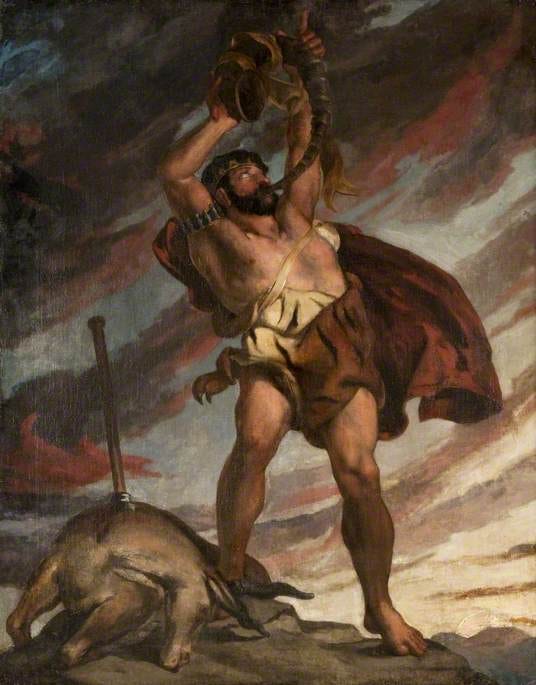
While Strabo is a late source, this tells us that Ninus must be Nimrod, the builder of Nineveh according to the Bible.
From Castor:
"Belus was the king of the Assyrians. During his reign, the Cyclopes brought lightning and thunder to assist Zeus during his battle against the Titans. At the same time, the kings of the Titans were in their prime - including king Ogygus." And shortly afterwards he says: "The giants attacked the gods, [p55] and were killed, after Heracles and Dionysus, who were descended from the Titans, came to the aid of the gods. Belus, whom we mentioned before, came to the end of his life, and was regarded as a god. After him, Ninus ruled the Assyrians for 52 years. His wife was Semiramis. After Ninus, Semiramis ruled the Assyrians for 42 years. Then Zames, who was also called Ninyas, [was king]."
Ogygus in the passage above is the leader of the Titans. Kuk and Gyg mean "old man" in the Anatolian languages, as in the later King Gyges/Kukis of Lydia who was defeated by Mursilis/Tugdamme/Lygdamis the Cimmerian in 661 BC. In this Greek myth Ogyges, the old man, was the leader of the Titans and is fairly obviously Noah. Belus is the predecessor of Nimrod, therefore we would guess he is probably Nimrod's father, Cush. Other sources state this explicitly.
From Cephalion:
"In ancient times, the Assyrians ruled over Asia, and Ninus the son of Belus was their king. In his reign, many great events occurred."
If Ninus is Nimrod, then since the Bible tells us that Cush begot Nimrod, then Belus, the father of Ninus must have been Cush.
Belus comes from Bel or Ba’al, and means Lord. This title also was applied by some to Ham.
From Eupolemus, Concerning Belus:
"For the Babylonians say that the first was Belus, who is the same as Kronus. And from him descended Belus and Canaan; and this Canaan was the father of the Phoenicians… Another of his sons was Khum, who is called by the Greeks Asbolus, the father of the Ethiopians, and the brother of Mestriam, the father of the Egyptians. The Greeks say, moreover, that Atlas was the discoverer of astrology."
We have to be careful with the identifications of Belus, because, as we can see, this title is sometimes applied to Ham and sometimes to Cush, and sometimes, also to Nimrod. Much later it was also applied to Sesostris III (Egyptian Belus) and Shalmaneser I (Assyrian Belus).
From Thallus:
"Thallus makes mention of Belus, the King of the Assyrians, and Kronus the Titan, and says that Belus with the Titans made war against Zeus, and his compeers, who are called gods. He says moreover, that Gygus was smitten, and fled to Tartessus."
Thalus has confused the younger Belus (Cush) with the older (Ham/Kronos). Here Gygus, or Ogyges, is mentioned again. It says that Gygus was smitten and fled to Tartessus in the very far West. The smiting of Gygus is probably a reference to the castration of Noah. The "Clash of the Titans" resulted in the flight of Noah to the West. This would have occurred during the Babel period which lasted from the division of the earth in the days of Peleg to the Dispersion in 2191 BC, 57 years later. The Chinese date the reign of Emperor Yao from the Flood to 100 years later, when he was asked to step down by his descendants. The flight of Gygus corresponds to the dethronement of Noah after the second division of the land, in the days of Peleg, 101 years after the Flood.
The Peruvians record that 150 years after the Flood Virachocha (Noah) commanded the peoples at Babel to go to their provinces and settle the world. This command was therefore given in 2198 BC, seven years before the Dispersion. Noah sent colonists and went with them arriving in Peru about 340 years after the Flood. (Montesinos, The Quito Manuscript) Atlantis is in some accounts connected with Tartessos, though there was also a city by that name in Spain, called Tarshish in the Hebrew text. Therefore the flight of Ogyges to Tartessus could refer to Noah taking the colonists under Maco Piru (Ophir) to Peru.
So now we have established a chain of six post-flood rulers from Noah to Ninyas Zames:
Bible Name: Pagan Names or Titles
Noah: Anu, Ouranos, Anus, Janus, Ogyges
Ham: Kronos, Kum-arbis, Belus I, Utu
Cush: Picus, Zeus, Belus II
Nimrod: Ninus
[?] : Semiramis. Will get to her in part III.
[?] : Ninyas Zames
That concludes part I. In Part II we will look at these characters in the Sumerian and Assyrian pantheons. In Part III we will examine the identities of Semiramis and Ninyas Zames.
Alalus might be a reference to Elohim.
Cory's Ancient Fragments