


According to the ancient mythographers and chroniclers, after the languages were confused at Babel there was a war beteween Kronos and Titan. In the previous episode, we learned that Nimrod tried to rule the world by force after the Dispersion. Building his new capital of Nineveh on the lower Tigris River, and being known by the name, En-Mer-Kar, Nimrod conquered Cappodocia, Subartu, and Canaan in seventeen years. During this campaign of conquest, En-Mer-Kar invented writing on clay tablets to send diplomatic messages to the Lord of Aratta (his grandfather, Ham).
How Nimrod Brought Writing to Egypt
In his twenty-eighth year (2163 BC) Nimrod traveled to Egypt, where he found his Uncle Mizraim ruling in the newly founded city of Thinis on the upper Nile. There he introduced pictorial writing on clay tablets, for which he was later remembered as Thoth, the god of wisdom.
“Varro in Augustin, says the Egyptians were taught letters by Isis 2,000 years before his time.’‘
—(Williams 1789, 147-148)
Varro was born in 116 BC.
116 BC, birth of Varro; plus,
2,000 years of writing in Egypt; gives:
2116 BC +/- 50 years for the introduction of writing into Egypt (2166 - 2066 BC)
“Plato in Phaedro expressly attributes the invention of the practice of letters to the Egyptian Thoth the Hermes or Mercurius Teismegistus thrice great of the Greeks but Thoth is understood to have been assistant and secretary to his father Mizraim and Mizraim was son of Ham Vide Diod Sicul lib i cap 8 35 Euseb Prep Ev p 36”
—(Calumet 1814, 202)
The Phoenician chronicler, Sanchoniatho concurs:
“Sanchoniatho attributes the invention of letters to Thoth the grandson of Ham From Misor Mizraim says he came Taautus who found out the writing of the first letters whom the Egyptians call Thoorthe and the Grecians Hermes. But Thoth died before Abraham entered into Canaan and consequently Letters were before the time of Abraham, Thoth however was not the inventor of Letters for I think it demonstrable that he received the elements of this knowledge from Noah. Even Sanchoniatho himself expressly asserts that Thoth imitated the art of picture writing practiced by Ouranus or Noah ... and delineated the sacred characters that formed the elements of this kind of writing.”
—(Oliver 1830, 117)
We find in Pliny another duration in myriads, similar to the two previous ones we found for 720,000 days to Babel, and 480,000 to Egyptian Belus creating the astronomical college. In the very same passage he writes, “Anticlides writeth, that one in Egypt named Menon was the Inventor of Letters, fifteen [myriad] Years before the Time of Phoroneus, the most ancient King of Greece: and he endeavoureth to prove the same by Monuments.” (Pliny 1847, VII.58, 250)
Phoroneus was one of the early kings of Greece. Clinton estimated the rule of Phoroneus to 1753 BC, with an error of +/- 16 years. (AP-19)
15 myriads is 150,000 days, or 410.67 Julian Years, with rounding error of 1.4 years. (Adding the error of our Anchro Point #19 gives a total error of 18.4 years for this duration.)
1753 BC rule of Phoroneus; plus,
411 years; gives:
2164 BC +/- 18.4 years that Thoth introduced writing to Egypt
Nimrod’s Soft Conquest of Egypt
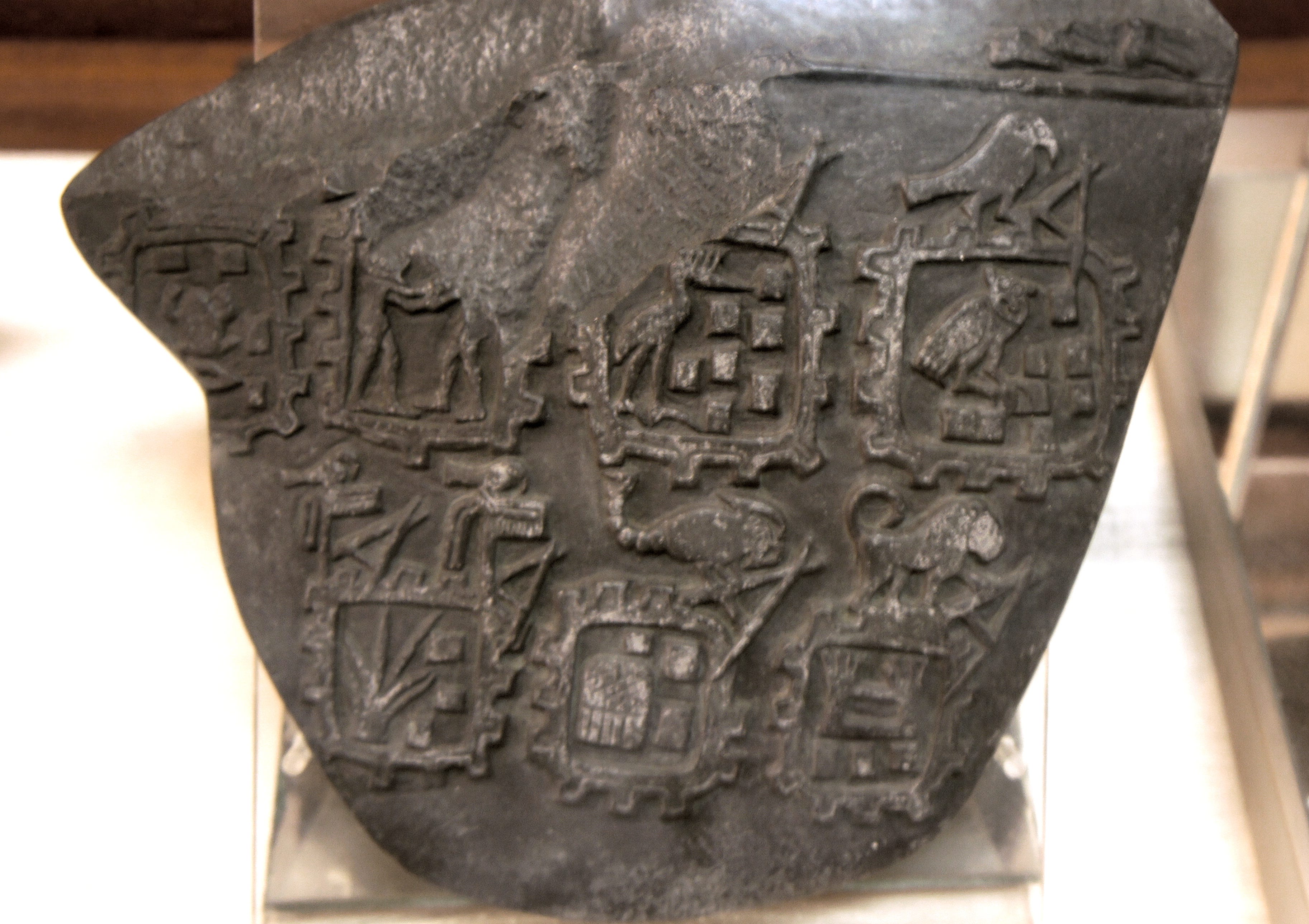
When Nimrod brought writing to Egypt in 2163 BC, he found his uncle Mizraim ruling the settlement of Thinis which was founded about 25 years earlier. Apparently Mizraim’s sons had each formed their own tribe and settlements, as reflected on the Libyan Palette, which shows seven founding cities of Egypt. Each city is shown with its own animal totem. We can see a scorpion, a baboon, an ibis, and twin falcons, among others.
Nimrod appears to have transliterated his Sumerian name, En Mer, meaning “Lord Storm,” into Egyptian as Nar-Mer, written as catfish-chisel. Due to the effects of the confusion of tongues his name Mer meant “catfish” in Egyptian. Later, the catfish became a sacred fish in Egypt because its connection to the name of Nimrod as Narmer.

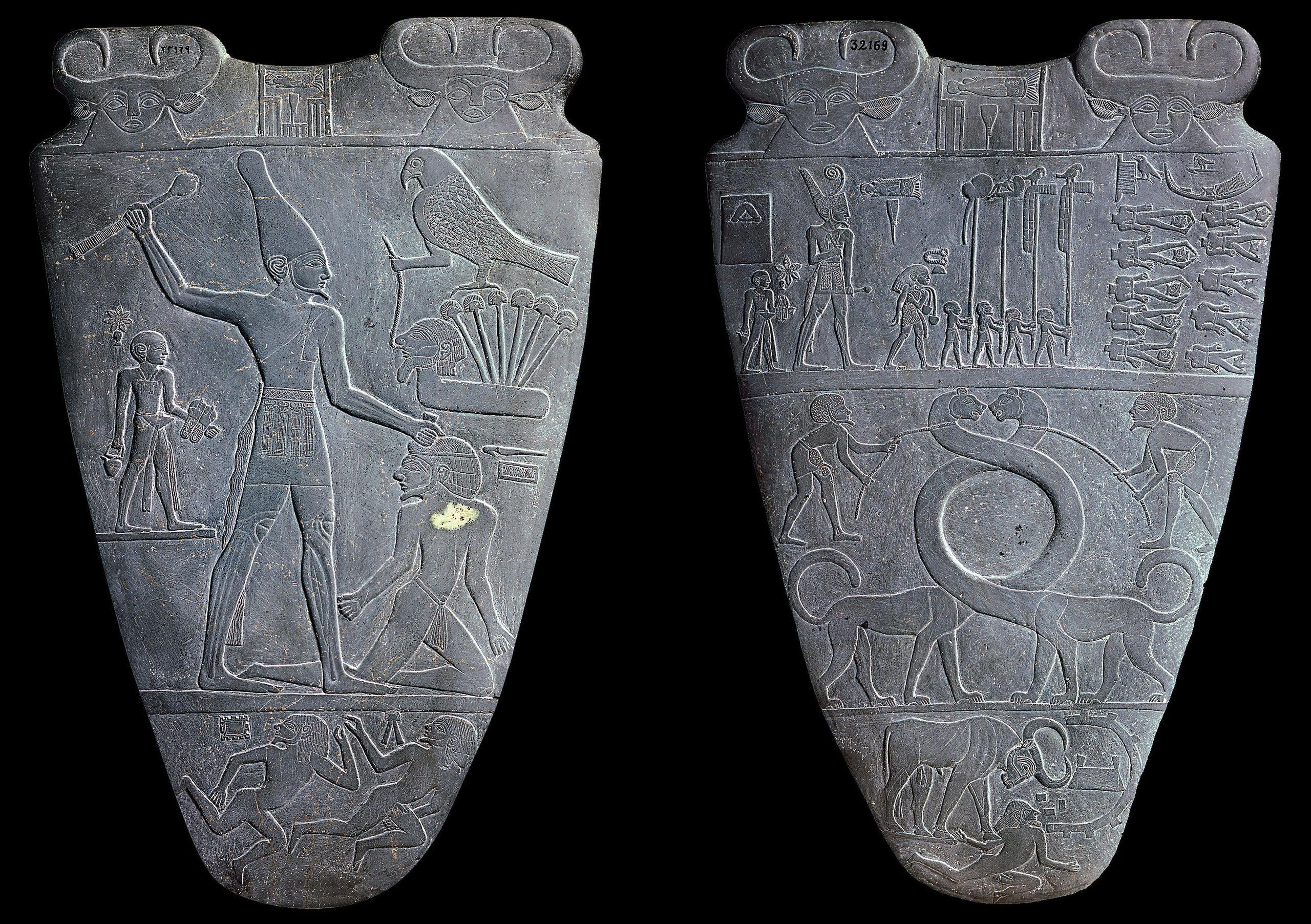
Nimrod, under his Egyptian name, Narmer, recruited his uncle Mizraim to fight a war to forcibly unite the seven tribes of Egypt under him. This war of unification occurred in 2163 BC and is depicted on the Narmer Palette.
In early Egypt, each year special objects would be gifted to the temple depicting the events of the previous year. The Narmer Palette dates to the year 2062 BC and depicts Nimrod’s conquest of the tribe of Egypt that refused his demand for unification under him.
Based on the Narmer Palette, it appears that only one tribe refused to unify and was made an example of. The Narmer Palette depicts Narmer (Nimrod) defeating the rebels. It shows the body of ten of the rebels decapitated on the ground. (It may also depict a pair of sauropod dinosaurs on the back.)
Horus versus Set
The Egyptian god, Set, appears to be based on Seth, while the god known as Horus the Elder was based on Cain. Cain was the first to use force to avenge himself upon Abel for whatever Abel did to offend him. By deifying Cain, Nimrod was self-consciously choosing the ethic that “might makes right.”
Nimrod’s religion was the Way of Horus, or the Way of Cain. He deified the Egyptian state as Horus, and its king as the incarnation of Horus. While the rituals may vary, in substance, Nimrod’s religion was the same as all humanist religions since then - man is his own god, and the state is the deification of man. As the embodiment of the state, the king was the avatar of the god Horus. The Egyptians called the king “Horus on Earth”, and one of his five titles was his Horus Name.
In Egypt the followers of Set appear to have been followers of the patriarchal religion taught to them by Noah, who was still alive when Nimrod unified Egypt. They worshipped God under the name Re, the God of Light. The religion of Set was ridiculed and parodied in early Egyptian writings, but eventually Set was syncretized with the set of gods associated with Horus and a peace was made that effectively allowed the Egyptians to worship either Horus or Set as long as they submitted to the primacy of the King.
Nimrod as Osiris
The contemporary inscriptions indicate that Nimrod was known under the name of Narmer when he was alive in Egypt. Later he was deified under the name Thoth, or Atothis, the god of knowledge, and as Osiris the warrior king who founded Egypt. In the next episode we will look at the deeds of Nimrod recorded under the name of Osiris.
this is an amazing synthesis of research