


The Kings of Tyre present three problems for Biblical chronology.
1. The Temple Was Founded 144 Years before Carthage
First, because Josephus said Solomon founded the Temple 144 years before Elissa founded Carthage, there has been much debate over when Solomon built the Temple and when the city of Carthage was founded. Several Roman sources seem to place the founding of Carthage in 814 BC, which suggests Solmon’s Temple was founded in 958 BC, which is 53 years later than the biblical chronology places the founding of the Temple. I have answered this problem in detail in the paper, The Foundings Dates of Tyre and Carthage. The simple answer is that Phoenician sources, the culture that actually built Carthage, unanimously place the founding of Carthage in 868 BC, agreeing precisely with the Ussher-Jones chronology of the Bible.
2. David’s Hiram Was Reigning 25 Years Before Solomon’s Hiram Came to the Throne
A second problem is that Josephus states that Solomon founded the Temple in the 12th year of King Hiram of Tyre, which scripture states to have been the fourth year of Solomon’s reign (1 Kings 6:1). However, 2 Samuel 5:11 says that Hiram of Tyre sent messengers to King David in the first year that he reigned in Jerusalem, which was seven years after he became king in Hebron, therefore 1048 BC. If Solomon’s temple was founded in the 12th year of Hiram, then Hiram’s reign began in 1023 BC. This means that David’s Hiram sent messengers and gifts 25 years before Solomon’s Hiram began to reign!
Academic scholars merely bend the scripture durations of David and Solomon’s reigns to force a fit for the reign of Hiram of Tyre. However, there is a simple and obvious solution that harmonizes the biblical data with that of Menander and Josephus. Josephus does not say how long that Abibaal, the father of Hiram reigned. We only know that he died 12 years before Solomon founded the Temple in 1011 BC. Therefore Abibaal died in 1023 BC. If his reign was about 20 years, then his predecessor would have been on the throne when David founded his throne in Jerusalem in 1048 BC.
Therefore, we can conclude that there were two kings of Tyre name Hiram. Hiram I was reigning in 1048 BC, and probably died within five years of that date. He was followed by Abibaal, with a reign of about 20 years. Hiram II took the throne in 1023 BC, eight years before the death of David in 1015 BC.

3. The Sums of Menander’s Reigns in Josephus Fall 19 Years Short of the Given Total
Josephus passed on two durations from Menander relating Hiram II and the Temple to the founding date of Carthage. He said the sum of reigns of all the kings from Hiram to the 7th year of Pygmalion, when Elissa founded Carthage, was 155 years. Elsewhere he wrote that the time from the founding of Solomon’s Temple in the 12th year of Hiram to the founding of Carthage was 143 years and eight months.
Table 1 lists the figures of Menander for the reigns of the kings of Tyre. Two problems arise from this data. Both the sum from the start of Hiram’s reign and the sum from the 12th year of Hiram’s reign fall 19 years short of the totals of 155 and 144 years given by Josephus. This suggests that there has been a scribal error when copying the reigns of one of the kings.
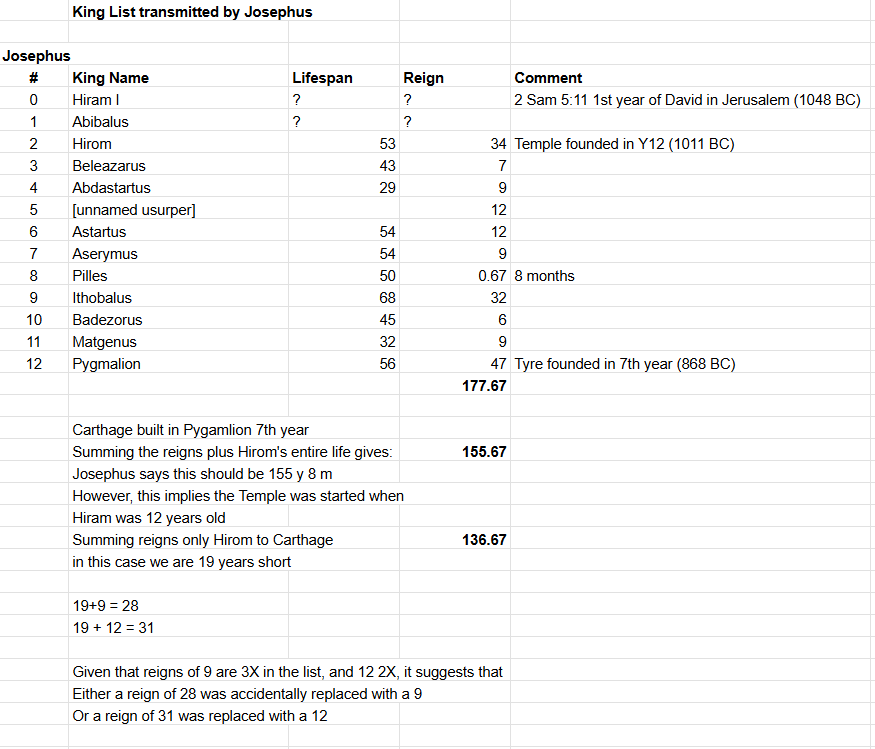
Scribal errors do not normally change a number with a completely new one. The most common error when copying a king list is for the scribe’s eye to wander to the wrong row, and thus copy the reign of a king above or below the row with the value that he meant to copy.
In all probability the scribal error is one of the repeated numbers. In Menander’s kings list, we see two 12’s and three 9’s. Since the list comes 19 years short, this suggests that a 19+9 = 28 was replaced by a 9, or a 19+12 = 31 was replaced by a 12.
Given that the only number repeated consecutively was 12, we will guess that the error was to replace the 31 year reign of either the unnamed usurper or Astartus with a 12.
Since Ahab married Jezebel, the daughter of Ithobaal, we can test this correction to see if the reign of Ithobaal still overlaps with the reign of Ahab.
We tested this correction in Table 2.
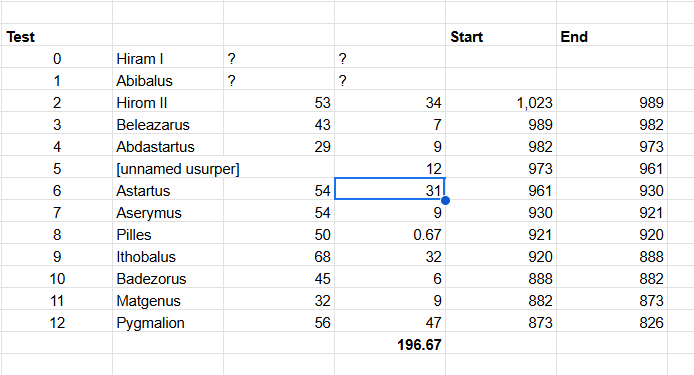
In the Ussher-Jones chronology of Scripture, Ahab reigned from 918 to 897 BC. As seen in Table 2 above, our test correction places the reign of Ithobaal from 920 to 888, thus overlapping with Ahab. Furthermore, we can deduce that Ithobaal came to the throne at the age of 36 by subtracting his years of reign from his length of life. If Ithobaal sired Jezebel when he was 20 years old, then she would have been 18 years old when she was given in marriage to Ahab in the first year of his reign. Therefore the test case passes.
Just to be thorough we tested adding the missing 19 years to the other 12 and the three 9’s in the list. As it turns out, the reigns of Ahab and Ithobaal still overlap no matter where we insert the 19 years in the list. However, if we insert the 19 years into the reign of Matgenus, it results in Ahab coming to the throne in the 21st year of Ithobaal as king, and the 55th year of his life. Both of those are still quite reasonable.
We conclude that while several solutions to the Ithobaal problem are possible, the most probable solution is to make the reign of Astartus 31 years. Table 2 can therefore be safely relied upon for the dates of the Kings of Tyre.
Conclusions
We may conclude that the city of Tyre was founded in 1251 BC, 240 years before Solomon’s Temple, and Carthage was founded in 868 BC, 143 years and eight months after the Temple.
The Hiram who sent messengers and gifts to King David in 1048 BC was Hiram I, the grandfather of Hiram II who supplied Solomon with the materials to build the Temple.
Ithobaal of Tyre most likely reigned from 920 to 888 BC, overlapping all of Ahab’s reign and outliving him by 9 years. This may also help explain how Jezebel was able to retain power after Ahab’s death. Her father was a powerful king of Tyre.
And finally, Pygmalion, the brother of Elissa, reigned from 873 to 826 BC and was contemporary with Akhenaten, Tutankhamun, Ay, and Horemheb of Eygpt. He was the author of nine of the El Amarna Letters, #146–#155, as Abimilki, meaning Abimelech, King of Tyre. Either Menander or Josephus transliterated Abimelech into Greek as “Pygmalion.”
Wow. Incredible detective work!