


I recently published paper number 13 in the Chronological Framework of Ancient History series, which seeks to make sense of the archaeologically missing Median Empire and the “earlier” Hittite Empire that classical historians seemed to know nothing about. We argue that the so-called “Hittite Empire” of Anatolia was in fact the missing Median Empire, which has been displaced by seven centuries because it is pegged to the defective Egyptian chronology. Below, I used Perplexity AI to generate a summary of the arguments in that paper. The full paper with charts and illustrations can be read here:
AI Summary of the Paper
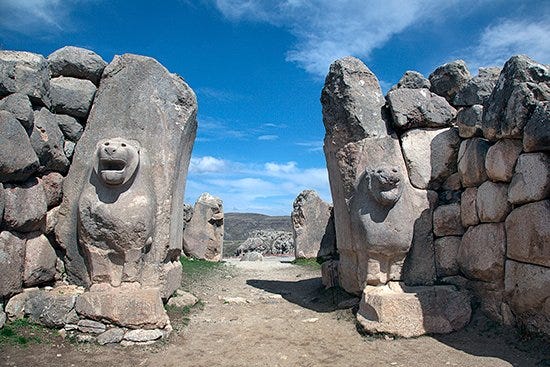
The paper argues that the so‑called New Kingdom “Hittite Empire” centered on Hattusa is in fact the western capital and bureaucratic expression of a late Iron Age Cimmerian–Median–Scythian coalition, and that several key “Hittite” kings are identical with named figures in Neo‑Assyrian annals and Greek historiography.
Core thesis and chronological claims
The authors contend that the archaeological “Median Empire” in Iran is largely missing, whereas the Hittite kingdom at Hattusa is archaeologically robust but inexplicably absent from Greek narrative sources.
They propose that New Kingdom Hittite rulers Mursilis II, Muwatallis II, and Hattusilis III are respectively Tugdamme the Cimmerian, Madyes the Scythian, and Cyaxares the Mede, so the Median “Empire” of classical authors is really a Cimmerian‑led coalition ruling from Hattusa ca. 705–547 BCE.
This reconstruction is embedded in the broader “Chronological Framework of Ancient History” (CFAH), which lowers Egyptian and Near Eastern dates, placing Ramesses II from 644–578 BCE, the Battle of Kadesh in 639 BCE, and the Treaty of Kadesh in 623 BCE, synchronizing them with late Neo‑Assyrian history and the rise of the Medes.
Hittites, biblical Hittites, and Tabal
The paper distinguishes the biblical Hittites (descendants of Heth in Canaan) from the later Anatolian kingdom of Hattusa, arguing that the latter’s name “Hatti/Kheta” overlaps geographically and linguistically with Syrian “Hatti land” but arises in a different period.
It traces biblical references to Hittites from Abraham through Joshua, David, and Solomon, arguing that Israelite expansion pushed Canaanite Hittites north into Syria, where they formed the Hatti/Hattina of the Amuq and later Tabal/Neo‑Hittite states.
Assyrian references to Tabal, Mushki, and related polities (Tubal and Meshech of Ezekiel) are reinterpreted as the Old/Middle/New Hittite phases, leading into the Cimmerian takeover and the emergence of a “Hittite” (i.e., Tabalian) royal center under Cimmerian control at Hattusa.
Key synchronisms: Mursilis II = Tugdamme
The central argument is a synchronism “cluster” equating Mursilis II with Tugdamme (Dugdammi) the Cimmerian based on four shared features:
Both campaign against Sardis/Ephesus and defeat a Lydian ruler whose name means “grandfather” (Uhhazitis vs. Gyges), argued to be dialectal variants of the same name.
Both reigns record a “thunderbolt/fire from heaven” event at or near Ephesus that injures or destroys the enemy, interpreted as a bolide airburst that later underlies the Ephesian cult of the “stone fallen from heaven.”
Both kings suffer a stroke‑like illness involving facial paralysis and speech impairment (Mursilis’ “mouth went sideways” vs. Tugdamme’s half‑body palsy and tongue injury in Ashurbanipal’s annals).
Both have a decisive solar eclipse omen interpreted in nearly identical divinatory terms (king or royal woman must die), which the authors fix to the precisely dated 15 April 657 BCE eclipse over Cimmerian territory.
By associating Mursilis’ eclipse campaign against Azzi (year 7 or 10) with the 657 BCE eclipse, they date Tugdamme–Mursilis’ accession to 667/664 BCE and the death of Gyges/Uhhazitis to 661 BCE, aligning this with Ashurbanipal’s third campaign chronology.
The authors argue that the probability of all four rare events coinciding twice, seven centuries apart, is effectively zero, so conventional Hittite–Assyrian chronology is displaced by roughly seven centuries.
New dating: Hittites, Babylonia, and Egypt
Using Berossus, the Sumerian King List, Larsa year‑names, and Babylonian King List B, the paper recalculates the fall of Akkad (to 1477 BCE), the life of Hammurabi, and the end of Babylon I, placing Mursilis I’s famous raid on Babylon in 851 BCE rather than the late second millennium, and linking it to a Kassite civil war described in Shalmaneser III’s annals.
Mursilis I (“Mushallim‑Marduk” in Assyrian eyes) thus becomes a player in ninth‑century politics, and the old‑Babylonian chronology is lowered to the early first millennium; this is set up for fuller treatment in CFAH‑14 and CFAH‑15.
The Dakhamunzu letter to Suppiluliuma I is likewise redated: the authors reject the standard identification with Tutankhamun’s widow, arguing instead for a queen of Necho‑Ramesses I (an Egyptian high‑king under Assyrian hegemony, killed in 664 BCE), amid conflicts involving Taharqa and Tantamani, Psammetichus’ flight, and Assyria’s reconquest of Egypt.
Within this framework, Suppiluliuma I becomes Partatua the Scythian (Prototythes/Phraortes in Herodotus), married to an Assyrian royal (Tawananna as Esarhaddon’s daughter), turning “Hittite” family politics into Scythian–Median–Assyrian dynastic politics.
Cimmerian–Median empire built from west to east
The authors challenge the standard model in which a Median state in Iran grows westward to absorb Urartu and Anatolia, insisting instead that power progresses from west to east: a western Cimmerian horde establishes itself in Tabal/Hattusa under Tudkhaliya III and Suppiluliuma I; Hattusa becomes a western capital; and only later does control extend over Central Iranian Media.
The Cimmerians are treated as closely entangled with Scythians and Medes, with Ishpaka (Ishkallu/Eshpai) and his son Partatua as early leaders, and Tudkhaliya III–Suppiluliuma I as their Hittite throne names.
The death of Sargon II in 705 BCE “on campaign to Tabal” is read as the Median revolt remembered by Herodotus and Ctesias, with Ctesias’ Arbaces and Sardanapallus narrative treated as a conflation of Sargon’s death and the later fall of Nineveh.
Evidence such as the Saqqez dish with a Luwian‑hieroglyphic inscription naming Partitavas (identified as Partatua) is used to argue that Scythian elites in Media adopted the Hittite writing system, confirming a Cimmerian/Scythian presence in the Hittite scribal milieu around 690 BCE.
Madyes/Muwatallis II, Cyaxares/Hattusilis III, and later history
Madyes the Scythian, who dominates Asia and the Medes for 28 years in Herodotus, is identified with Muwatallis II, the Hittite king who battles Ramesses II at Kadesh; his “28 years” are read as overlapping the reigns of Muwatallis II and his successor Mursilis III.
Hattusilis III is identified as Cyaxares the Mede, whose Hittite title “Kheta‑sar” (“king of Kheta/Hatti”) is argued to underlie the Greek form “Kyaxares”; Hattusilis (“man of Hattusa”) and Khetasar would be complementary throne titles for the same ruler.
Within the revised timeline, the Battle of Kadesh (Muwatallis II vs. Ramesses II) occurs in 639 BCE, corresponding to Madyes’ invasion of the Levant, and the Treaty of Kadesh (Ramesses II and Hattusilis III) falls in 623 BCE, just as Cyaxares and Nabopolassar launch their war on Assyria.
This treaty secures Egypt’s flank with the Cimmerian–Median coalition; the authors suggest it may explain later Judahite resistance to Necho II (Josiah’s death in 609 BCE) as an attempt to uphold an older Egyptian–Median arrangement.
Extended synchronism network and king‑list harmonization
A long sequence of synchronisms is assembled linking Hittite kings of Old/Middle/New phases with Assyrian rulers (Ashurnasirpal II, Shalmaneser III, Tiglath‑pileser III, Sargon II, Sennacherib, Esarhaddon, Ashurbanipal), Lydian kings (Midas, Gyges, Alyattes, Croesus), and Median kings in Herodotus and Ctesias.
Labarna I and Hattusilis I are tied to Ashurnasirpal II and Shalmaneser III; Middle‑Kingdom Tudkhaliya II and Arnuwanda I are linked to Tiglath‑pileser III and Sargon II as puppet kings in Tabal; Mita of Mushki (Midas of Phrygia) surfaces in both Assyrian and Hittite texts, anchoring the middle chronology.
A composite king list is constructed in which Herodotus’ Deioces, Phraortes, Cyaxares, and Astyages, Ctesias’ parallel sequence, Hittite Tudkhaliya III–Suppiluliuma I–Mursilis II–Muwatallis II–Hattusilis III–Tudkhaliya IV–Suppiluliuma II, and Scythian/Cimmerian names (Ishpaka, Partatua, Tugdamme, Madyes) are all cross‑identified or aligned.
Late Hittite Tudkhaliya IV is equated with Astyages; conflict with an unnamed “king of Assyria” in Hittite letters is re‑attributed to Nabonidus rather than Shalmaneser/Tukulti‑Ninurta, on the grounds that Levantine and later Greek sources often call the Babylonian king “king of Assyria.”
Suppiluliuma II, last Great King of Hattusa, is identified as Cyaxares II/Darius the Mede (from Xenophon and Daniel), whose campaigns in Lycia and Tarhuntassa are equated with warfare against Croesus and Nabonidus leading up to Cyrus’ conquest of Babylon.
Hartapu, a Hittite prince ruling in the Konya plain, is proposed as Harpagus, the Median general who aids Cyrus and later becomes satrap of “Asia,” using Hittite/Arzawan evidence to backfill Greek accounts.
Interpretive conclusions
The authors argue that once Mursilis II is accepted as Tugdamme and Hattusilis III as Cyaxares, the Hittite archives furnish the missing internal history of the Median/Cimmerian Empire: a line of kings using Hittite throne names but remembered by Greeks under Median and Scythian ethnonyms.
“Median Empire” is thus recast as a convenient classical label for a Cimmerian‑dominated federation of Cimmerians, Scythians, Medes, Manneans, Urartians, and Tabalians, with Hattusa as a major western capital linked to Media by the Persian Royal Road.
Herodotus’ neat genealogy from Deioces to Astyages is taken to compress co‑regencies, hostage princes, and succession by sons‑in‑law or nephews, much as the Hittite succession often passes through marriage rather than direct patrilineal inheritance.
The paper closes by asserting that this re‑identification of New Kingdom Hittites with Cimmerian–Median rulers both explains the archaeological absence of “Median imperial” material in Iran and the textual absence of “Hittites” in classical narratives, while vindicating the lowered, duration‑based CFAH chronology developed in earlier installments.