


Homer wrote the Illiad and the Odyssey late in the reign of King Ahab of Israel, circa 900 BC. However, his account of the Illiad and the Odyssey was set early in the twelfth century, three hundred years before his own time. In Book 9 of the Odyssee Homer tells the tale of Odysseus and the Cyclops giant named Polyphemus. Odysseus came to his cave bearing gifts and seeking hospitality, but instead Polyphemus trapped them inside the cave and devoured six of Odysseus’ men, without even bothering to cook them.
Whether a tribe of one-eyed men such as the cyclops ever existed, we might seriously doubt. But we do know from Scripture that there were giants on the earth in those days and also afterwards. The accounts of such giants from many different cultures are consistent. Whatever their degree of civilization might have been, they often lived in caves, and ate humans.
In search of evolutionary ancestors of mankind, evolutionary archaeologists discovered a cave system near Atapuerca, Spain that dates back 1.2 million years according to them. I would instead argue that it dates to the first six centuries after the Flood, probably around 2000 to 1800 BC. The world was in the grip of the Ice Age, and the glacial maximum was near at hand. The massive mixed herds of tropical and temperate climate animals around the shores of the North Atlantic had begun to diminish as the climate drastically cooled because the ocean warmth that caused the heavy precipitation of the Ice Age had been exhausted.
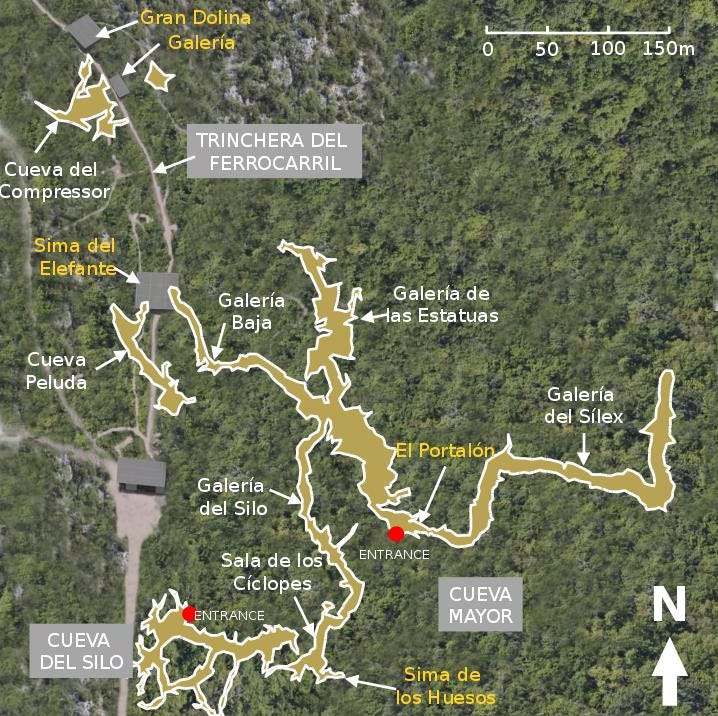
In this cave system they found remains of Neanderthals along with an even earlier clade of men called Homo Heidelbergensis. However, more than 30% of the human remains found in the caves had been subjected to bone cutting, breaking, and cooking, similar to the animal remains found there. Whoever ate them was cooking and cracking the bones to eat the marrow.
Most of the cannibalized human remains belonged to children under ten years of age. The archaeologists concluded that the people who lived in the cave preyed upon the children and teenagers of another tribe of humans who lived in the region.
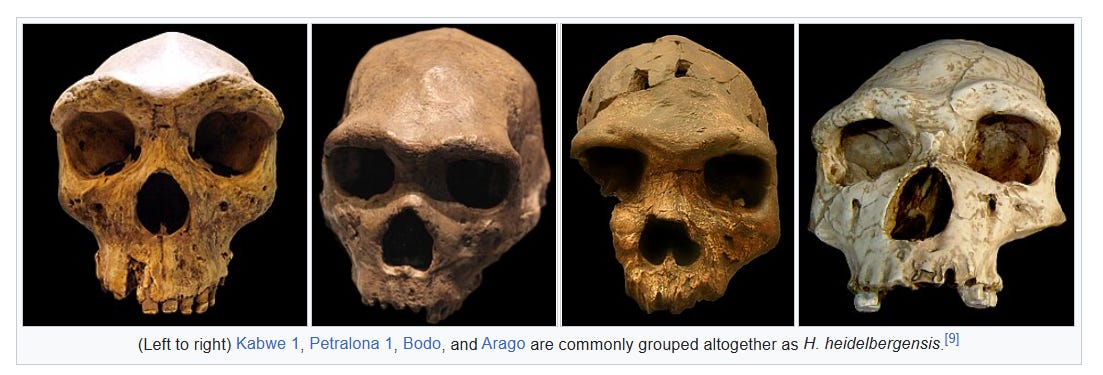
From the biblical worldview, we know that people before the Flood lived nearly 1,000 years. With such incredibly long lives, their skeletons may have aged differently, or more completely than modern humans do.
After the Flood men continued living over 500 years for the first three generations, however, their lifespans gradually diminished to the current value of 80 to 120 years by the time of Moses.
The orthodontist, Frank Cuozzo, wrote a book called Buried Alive, in which he argued that the brow ridges of the early humans such as Homo Heidelbergensis, Homo Neanderthalus, and Homo Erectus were simply the result of humans living over 150 years in age. Every time we chew food, the stresses on our skull cause the brow ridge to add a little more bone. A human who lived to be centuries old would be expected to develop a brow ridge such as those found in these early human skulls.
Returning to the human remains found in Atapuerca, it seems likely that the creatures who were eating the children of the other tribe were among the Nephilim, not unlike the Cyclops encountered by Odysseus in the same region a few centuries later.
Thank you for the article.
What do you think about the mystery of the elongated skulls of Paracas?
It is said in this regard that "The cranial volume is up to 25 percent larger and 60 percent heavier than conventional human skulls, meaning they could not have been intentionally deformed through head binding/flattening. They also contain only one parietal plate, rather than two."
Can they be post-diluvian Nephilim?