


When we think of ancient history, Ireland is not typically a nation that comes to mind. However, the Irish are one of fewer than ten nations that preserved their own history and chronology all the way back to Babel or the Flood. We just published our most recent paper in the Chronological Framework of Ancient History Series, CFAH-18: The Ancient History of Ireland (must be logged in to academia.edu for the link to work).
We used several medieval Irish sources, some of which date as far back as the eighth century, to create a composite history of Ireland, which saw five waves of colonization from the time of Babel down to the invasion of the sons of Mileadh in the reign of King David. The Milesian dynasties of Irish kings and clan chieftains has continued since then down to the present time. In this post, I will present a short review of that history.
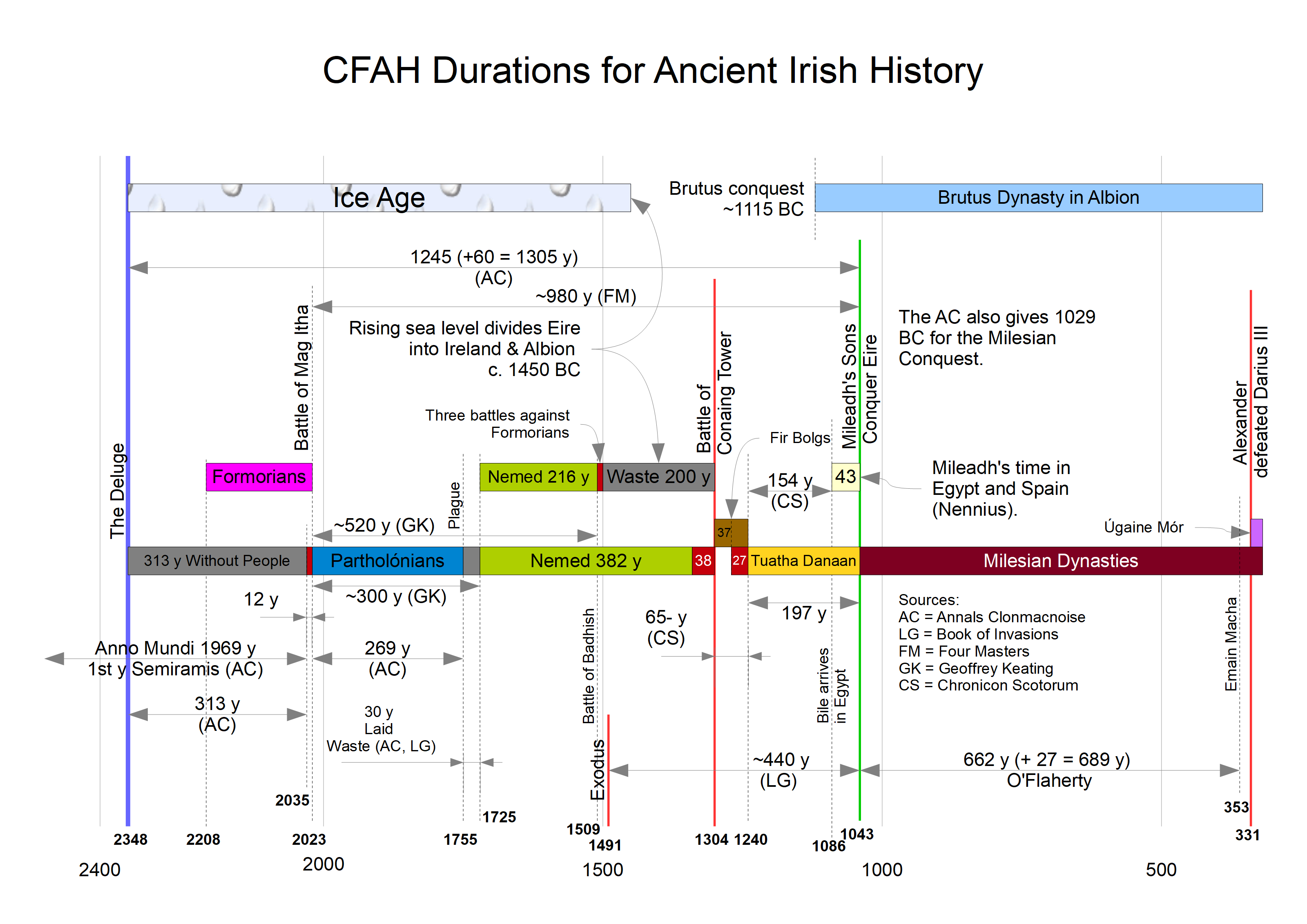
The Formorians: 2208 - 1043 BC
According to Keating, the first sighting of Ireland after the Flood was made by a man named Adhna, who landed, took soil from it to claim it 140 years after the Flood, and then reported the find back in Babel. Cichol, from the household of Sidon, and father of the Formorians began hunting and fishing there shortly afterwards.
The Formorians were a fierce people who were the primary foreign enemy of the Irish colonies for about a thousand years. Given the record that they were “of the sept of Ham”, we might identify them with the Soulutrean Culture of the mainland of Western Europe, whose Y-DNA halogroup was in the family C, which Ryan Fortner has identified as being Canaanite.
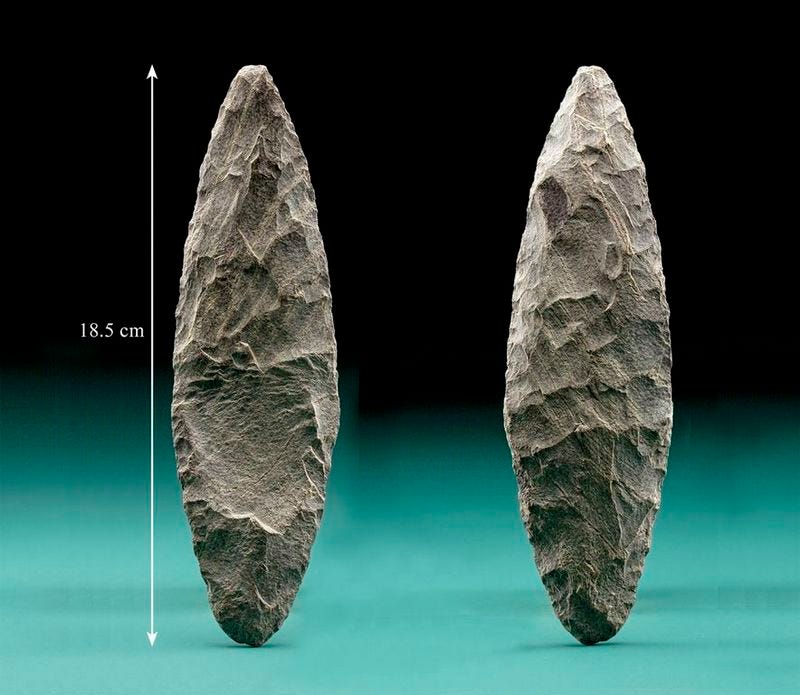
Partholon’s First Colony
Partholon, descended from the Tribe of Magog left Babel and began camping and hunting in Ireland 313 years after the Flood, in the first year of Semiramis, who appears in the Sumerian Kinglist as Dumuzi (2035 BC). After several years he encountered Chicol, father of the Formorians, and defeated him in battle at Mag Itha in 2024. Partholon founded the first permanent settlement in Ireland in 2023 BC.
At that time the Ice Age was nearing the glacial maximum, when the oceanic sea level was about 450 feet (144 meters) below the present sea level. Due to the lower ocean level, the continental shelf was exposed so that Ireland and Britian were connected to the French mainland.
Partholon’s colony lasted 269 years until it was devestated by a plague. One of the survivors was Nemed, who returned to the Ancient Near East for about 30 years before returning with a new group of colonists who were probably from the Yamnaya Culture.
The Nemedian Colony
The Nemedian Colony lasted from 1725 BC for about 420 years. About halfway through that period, they fought three battles against the Formorians around 1509 BC. Shortly afterwards the events of the Younger Dryas Event, the same year as the Exodus (1491 BC), led to the Baltic Ice Dam breaching unleashing a massive flood that destroyed the lowands, now under the North Sea and carving out the English Channel. The survivors were those who lived inland on higher ground. But the now weakened Nemedian Colony increasingly fell prey to the Formorian raiders. The Formorians established a fortress on an island off the northern coast of Ireland and built Conaing Tower. Their king demanded a tribute of half the crops and children born to the Nemedians every year. In 1304 BC the Nemedians fought a great battle against the Formorians at Conaing Tower, but the victory as Pyrrhic, and the colony collapsed.
The Fir Bolgs
One of the Nemedians had returned to the mainland in Belgium and then came back with a group of colonists called the Fir Bolgs. These ruled Ireland undisputed for 37 years from 1304 to 1267 BC, contemporary with the Ur III civilization in the Ancient Near East.
The Tuatha De Danaan
In 1267 BC a related group called the Tuatha De Danaan invaded Ireland. It took them 27 years to secure complete control, which was finally achieved in 1240 BC, the same year that Ur III fell to Isin. The Tuatha De Danaan basically means the Tribe of Danaan, and were conceivably related to the Mycenean Danaans described in Homer’s Illiad, as well as the tribe of Dan, which according to Scripture were dwelling in ships around that time. Modern constructions that Tuatha De Danaan meant the people of the goddess Dana, is pseudo-historiography and should not be taken seriously.
The Arrival of the Milesians - 1043 BC
One of the Irish families had gone back to Scythia with the tribe of Magog, and then worked as mercenaries in Egypt around 1086 BC. This was the end of the 17th Dynasty when the upper Egyptians were fighting to expel the Hyksos Amalekites. The man named Mileadh fought for the Egyptians and was given a daughter of Pharaoh named Scota to wife in gratitude. He and his people left Egypt around 1073 BC, which was the year after Saul and Jonathan defeated Agag the Amalekite in alliance with Ahmose I of Egypt’s 18th Dynasty. They wandered for 30 years sailing West and colonizing Spain, before deciding to move to Ireland. While Mileadh died before arriving in Ireland his wife and sons landed in 1043 BC and defeated the local Irish chieftains establishing the Milesian Dynasty. The descendents of Mileadh have been the kings and chieftains of Ireland from that day until this.
Connection to the Yamnaya People
It seems odd at first reading that the Irish claim each successive wave of colonists were descended from Magag and the Scythians. However, Y-DNA studies seem to support this claim. The first settlers in Ireland were from haplogroup I, which Ryan Fortner argues is Semitic. However, in the Neolithic times they were overwhelming replaced by the Yamnaya people who originated on the steppes of Russia and Ukrain (Scythia), and flooded Scotland and the UK to the point that their Japhetic R1b haplogroup is found in the majority of Irish and British men to the present time. The Yamnaya bloodline became dominant, probably with either the Nemedian or Fir Bolg colonization of Ireland between 1725 and 1300 BC. Thus the Irish claim to be descended from Magog seems to hold true in the DNA results.
This reminds me of the Minoans on Crete and their human sacrifice. King Minos was the son of Europa of Sidon, like the Formorians were from Sidon. Athens had to send human tribute to the Minoans to be sacrificed until Theseus volunteered and killed their minotaur. And the archaeology matches the story. There is an archaeological site where an earthquake killed Minoans in the act of sacrificing a human, and there is evidence of an upheaval (but not full on destruction) and the rulers changing from Minoan to Mycenaean Greeks.
I wonder where this mysterious Conaing's tower is, maybe under the sea now. Thankyou so much for the article :)
For anyone interested in the genetic data behind this, the first wave of Homo sapiens in Europe was related to east Asians and Aborigines. Their Y chromosome (paternal lineage) is generally either K (more common towards the east) or C (more common toward the west). Branches of both are more common in Asians and Aborigines today. C does seem to come from Ham originally, but mixed in with the K people very early. This could mean that Canaan mixed in with some European Japhethites like Javan or Tiras.
After that, a group with more Middle Eastern DNA arrives in greater numbers throughout Europe, and their Y chromosome is typically I, a relative of J, a group most common among Semitic people. The I group probably came from one of Shem's sons, maybe Aram or Asshur.
There are more waves, but the next one that makes it to the British Isles is actually a mixed group from central Asia (where Magog's people went), now known as the Yamnaya people. They often carry a much later branch of K called R, despite being otherwise more closely related to the descendants of Shem in the Middle East. They are the biggest contributors to modern European DNA.
https://originsinorder.substack.com/p/after-babel-paleo-genetics-overview