


According to Plato, the Greeks endured four great floods, each of which reset civilization. We can date these floods, which in turn give us information about when the Ice Age actually occurred in human history.
Flood of Deucalion I - Noah’s Flood: c. 2383-2316 BC
Diodorus places the great Flood less than 1,200 years before the Trojan War. Varro and Censorinus dated the Flood to 1,600 years before the Olympiad. Both durations being rounded to the century, we get a range from 2383 to 2326 BC, bracketing Ussher’s date of 2348 BC. In the paper, CFAH-4, the authors brought in durations from Chinese, Hindu, and Hebrew cultures to triangulate a precise date of 2348 BC for Noah’s Flood.
Flood of Ogyges: c. 1720-1699 BC
Acusilaus of Argos (6th century BC) related that the Flood of Ogyges in Boeotia occurred in the time of Phoroneus. The Ogyges flood was also mentioned by Hellanicus, Herodotus, Plato, and Pausanius all of whom associated the flood of Ogyges with the reign of Phoroneus in the Peloponnesus. Syncellus and Africanus appear to have conflated the Flood of Ogyges with that of the second Deucalion.
Syncellus, following Africanus, dated the Flood of Ogyges to the 80th year of Moses and the 55th year of Phoroneus. In the paper CFAH-3, Anchor Point #19, we triangulated the reign of Phoroneus to 1753 BC, therefore his 55th year was 1699 BC. Other chroniclers following the inflated chronology of Castor of Rhodes place Phoroneus about a century earlier. We accept both durations from Syncellus, but recognize the 80th year of Moses to be referring to the second Deucalion Flood, below, while the 55th year of Phoroneus refers to the Ogyges Flood in 1699 BC.
Flood of Deucalion II + Fire of Phaethon: 1523 or 1491 BC?
The myth of Phaethon is one of the most debated in classical scholarship — the question of whether it preserves a memory of a real catastrophic event involving a comet or asteroid, rather than merely being a solar metaphor, has been seriously argued since antiquity.
Phaethon was the son of Helios (the sun god) and the mortal Clymene. Doubting his divine parentage, he traveled to his father’s palace and begged to drive the solar chariot for one day. Helios, bound by a sworn oath, reluctantly agreed. Phaethon immediately lost control of the immortal horses, which veered off course — first soaring too high into the heavens, then plunging too close to the earth.
The consequences were catastrophic:
The sky and earth caught fire from the highest regions downward
Rivers and lakes dried up, and forests ignited
Whole nations were burned to ash
The Ethiopians had their skin scorched black
The Sahara and other deserts were created by the scorching heat
Even Atlas could barely hold up the white-hot sky
Zeus intervened, striking Phaethon dead with a thunderbolt. His flaming body plunged into the River Eridanus (later identified with the Po in Italy), leaving a long trail of fire across the sky as he fell. His sisters, the Heliades, wept on the riverbanks and were transformed into amber-weeping poplar trees.
Was It the Sun — Or Something Else?
Ancient thinkers themselves were divided, and the debate has continued into modern scholarship.
The solar metaphor view holds that Phaethon is simply an allegory for the sun’s erratic behavior — an unusually hot summer, or a solar myth explaining why the sun’s path varies.
The catastrophist view — held by several ancient writers and many modern researchers — argues the myth preserves a folk memory of a real astronomical event, most likely a comet or large bolide impacting or passing near Earth. Key evidence cited:
Plato explicitly addresses Phaethon in the Timaeus (22c–d), where the Egyptian priest tells Solon: “There is a story that even you have preserved, that once upon a time Phaethon...set the earth on fire...this story, as it is told, has the fashion of a legend, but the truth of it lies in the occurrence of a shifting of the bodies in the heavens which move around the earth.“ Plato thus explicitly rejects the solar chariot as literal and points to an astronomical body shifting its path.
The detail of a long trail of fire across the sky as Phaethon falls matches a bolide or comet far better than any solar event.
The River Eridanus, where Phaethon’s body lands, was associated by some ancient authors with the amber-producing northern rivers (Baltic region), which has led researchers to suggest the myth points to an impact or airburst in northern Europe or the Po Valley.
The Heliades’ amber tears is significant: amber was understood to be fossilized tree resin, and large deposits of amber along the Baltic and northern Italian rivers were connected to catastrophic burning of ancient forests.
Some researchers, including Clube and Napier in their Cosmic Winter (1990), have argued that the Phaethon myth belongs to a broader cluster of ancient catastrophe traditions — including Deucalion’s flood, Ogyges, and the plagues of Egypt — all pointing to cometary or asteroidal activity around 1500–1200 BC. Notably, astronomers have since named a real “rock comet” asteroid (3200 Phaethon) — a sun-grazing object that produces the annual Geminid meteor shower — after the myth, given how aptly the legend describes a body that comes dangerously close to the sun.
In short, the weight of both ancient and modern interpretive evidence leans toward Phaethon being a mythologized memory of a real extraterrestrial event — most likely a large comet or bolide — rather than a pure solar allegory.
Were the Fire and Flood in the Same Year?
The ancient sources are remarkably consistent in linking the Fire of Phaethon directly with a flood, treating them as two parts of a single catastrophic sequence, not as isolated events.
Censorinus (3rd century AD) explicitly ties both catastrophes to the Great Year: “There is a Great Year, whose winter is a great flood and whose summer is a world conflagration“.
Several ancient sources directly synchronize Phaethon’s fire with the Flood of Deucalion, placing them in the same reign:
Clement of Alexandria described Phaethon as “a figure associated with the burning and flood of Deucalion during the time of Crotopas” — Crotopas being a king of Argos.
Nonnus of Panopolis (Dionysiaca) describes the stars being thrown from their positions during Phaethon’s conflagration, and then a subsequent reordering of the heavens during Deucalion’s flood — strongly implying both events involved a shift in the heavenly bodies.
The consistent ancient picture is:
First: Phaethon’s fire — a scorching conflagration that burned rivers, forests, and whole nations.
Then: A great flood (Deucalion/Ogyges) — waters rising to purge the scorched earth
This sequence actually makes physical sense in a bolide impact scenario: a large impacting body could cause immediate firestorms, followed by massive flooding from displaced ocean water or melted ice.
This is precisely the kind of catastrophic sequence that researchers like Clube and Napier, and more recently Randall Carlson, have argued is embedded in Greek mythology as a folk memory of real mid-2nd millennium BC events.
The Greek sources for the date of the second flood of Deucalion are somewhat contradictory. Deucalion II was alleged to be a son of Minos of Crete. However, as Minos could not have lived long enough to have experienced everything attributed to him by the myths, Diodorus Siculus and Castor of Rhodes postulated two kings by that name, Minos I and Minos II. Minos I was placed in the generation of other characters who lived about 1520 BC, whereas Minos II was placed by Thucydides three generations (100 years) before the Trojan War (~1300 BC). If we recognize Deucalion II as the son of Minos I, this places his reign in the range of 1500-1400 BC.
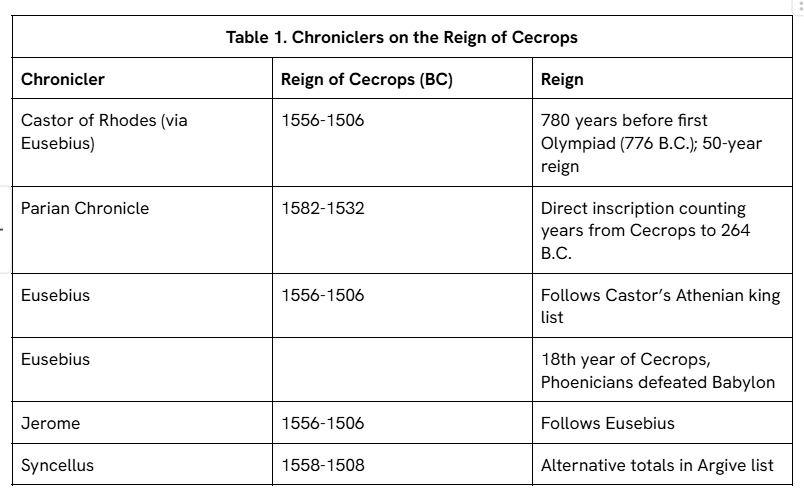
The Fire of Phaethon and the second Flood of Deucalion are also associated with Cecrops, King of Athens, and with Crotopus, King of Argos. The range of the dates for Cecrops is rather wide (Table 1), however the range of the dates for Crotopus of Argos is much narrower (Table 2). The problem is that the dates of Castor and Eusebius for Cecrops have him dying about a decade before Crotopus came to the throne.
All of the ancient chroniclers who dated Cecrops appear to have followed either Castor of Rhodes who inflated dates by five to thirteen decades due to misidentifying the death of Sardanapallus (Ashur Danin Pal) in 820 BC as the end of the Assyrian Empire, or the Parian Chronicle, also from the Cyclades, which inflated the dates even more than Castor did.
Fortunately, a fragment of Eusebius preserved by Ussher gives us a precise date for the reign of Cecrops which enables the confusion to be resolved, and harmonizes most if not all of the conflicting information.
164. In the 18th year of Cecrops, the Chaldeans made war and fought with the Phoenicians. (Eusebius Chronicle, 1.1.1:61)
165. In this war the Chaldeans were defeated, and the Arabians reigned in the country of Babylon for two hundred and sixteen years before Belus the Assyrian came to reign. (Ussher 2003, §164,165)
In the paper, CFAH-5, the authors identified this event as the Fall of Akkad to the Amorites of Canaan in alliance with the Gutium (Anchor Point #35). “Belus the Assyrian” refers to Shalmaneser I who began to rule in 1261 BC, as per the Assyrian King List. This date is also confirmed by Berossus who placed the “Arab Dynasty of Babylon,” which overthrew the Akkadian Dynasty, 245 years before Tukulti Ninurta I conquered Babylon in 1232 BC. Both durations yield 1477 BC for the Fall of Akkad. Using 1477 BC for the 18th year of Cecrops places his fifty-year reign from 1495 to 1445 BC, overlapping both the Exodus and Joshua’s Conquest. This double overlap is important because it fits specific details from the mythology of Cecrops that we will explore below.
More germane to the question of the date of the second Deucalion Flood, using this duration from Eusebius, and assuming Deucalion II was the son of Minos I, places Cecrops, Crotopus, and Deucalion II as contemporaries. So now we have brought the three kings associated with the Deucalion Flood into the same time band of 1495 to 1481 BC, let’s look at the details of the Phaethon Fire and Deucalion Flood.
Key Synchronisms Recorded by Castor and Eusebius
The chronicle explicitly states that during the reign of Cecrops:
Moses became recognized among the Hebrews
The Fire of Phaethon devastated Ethiopia
The Flood of Deucalion occurred in Thessaly
Eusebius specifically states that during the reign of Crotopus, two things occurred:
“Phaethon’s burning of Ethiopia” — the great conflagration
“Deucalion’s flood in Thessaly” — a great deluge of lands along the Aegean Sea.
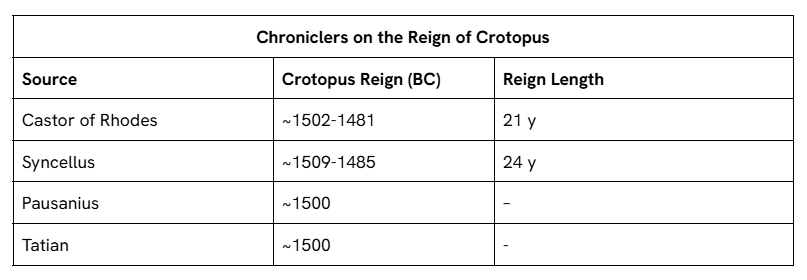
This means ancient chronographers placed both the Phaethon fire and the Deucalion flood squarely in the decade between 1495 and 1481 B.C. Syncellus, conflating the Flood of Ogyges with the Flood of Deucalion, placed it in the 80th year of Moses, which Ussher dated to 1491 BC.
What else of global biblical significance occurred in 1491 BC? In Ussher’s chronology, the answer is the Exodus - when Moses became recognized among the Hebrews, and God displayed Himself as a pillar of fire in the sky.
In one of our previous papers we used the dating of Eusebius and the 73-year duration recorded by Clement of Alexandria, citing Thrasyllus, between the floods of Deucalion and Dardanus, to place the Fire of Phaeton in 1523 BC.
Upon further examination and comparison of all the factors, the authors have come to the conclusion that the Fire of Phaeton and Flood of Deucalion II were almost certainly the Greek memories of the terrifying global cataclysm that surrounded the Exodus itself in 1491 BC.
The Flood of Dardanus: 1450 BC
According to Dionysius of Halicarnassus, Dardanus originally left Pheneus in Arcadia to colonize land in the northeastern Aegean. When his deluge struck, the low-lying lands were inundated and the mountain on which he and his family took refuge became the island of Samothrace. Dardanus then escaped to Asia Minor on an inflated animal skin, landed near Abydos, and settled on Mount Ida. So afraid of another flood were his people that they refused to build a walled city for fifty years, living in the open. His grandson Tros finally descended from the highlands and built the city that became Troy.
How can we date the Dardanus Flood? Clement, citing the accepted Greek chronology of his time, identified the Flood of Dardanus around the same time as the invention of iron by the Dactyls and first Olympic Games in Elis circa 1453 BC. The Dardanus Flood appears to have occurred a few years after those first games. Clement also dated the Dardanus Flood as 73 years after the second Deucalion Food. Above, we attribute that to his use of Castor’s chronology, making his date for Deucalion about a generation high.
Three additional durations enable us to further narrow the date of the Flood of Dardanus to the year, but they require interpretation.
The Sinking of Madura 1,850 years before Ukkirapperuvaludi
The second duration is given to us from Tamil literature. The Sangam was an academy of poets in the old city of Madura in the prehistory of the Pandya Dynasty which included south India and the northern half of Sri Lanka. The Sangam had three periods, the middle of which was ended by the rising of the sea which drowned the city of South Madura, forcing the academy to move to the new capital Uttar Madura (North Madura), which still exists today. \
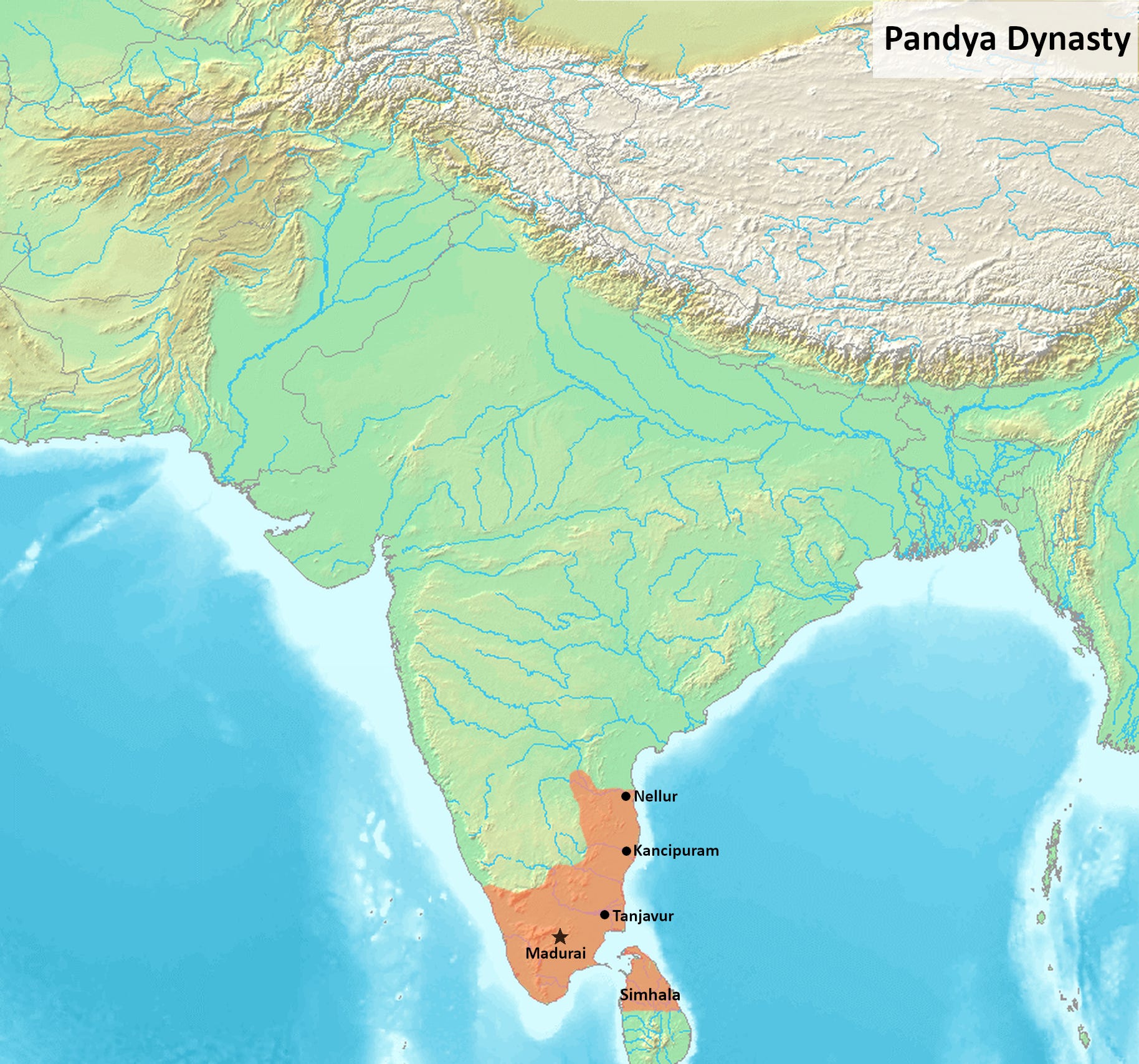
The sages recorded that the third Sangam lasted 1,850 years from the destruction of Madura by the sea until the reign of Ukkirapperuvaludi.
The last Sarigam consisted of forty-nine members… This Sangam lasted for 1,850 years. Forty-nine were the kings who patronized this Academy commencing with Mudattirumaran who established his capital at Madura when a portion of his kingdom was devoured by the sea. The last patron of this Academy was Ukkirapperuvaludi. The meeting place of the Sangam was the Uttara Madura (North Madura, the modern city of Madura).
– (Dikshitar 1930, 8)
Dikshitar cites three additional witnesses to the drowning of the city forcing the relocation of the capital to Uttar Madura:
Change of venue, a probable historical fact. A significant circumstance in this connection is that the above legend refers to the change of the Sangam headquarters from Daksina Madura to Kavatapuram and from the latter to the Uttara Madura or the modern city of Madura. This is a probable historical fact The change of the capital of the Pandyan kings is confirmed by other literary references and corroborated by the classical writer Pliny, who refers to the transfer of capital from Korkai to Madura. The incident of the sea swallowing a portion of the Pandyan territory is attested by a reference in the Silappadikaram and in the Kalittoai.
In his gloss on the Silappaddikaram, Adiyarkkunallar refers to this incident and says that the extent of the territory devoured by the sea was 700 Kavadam or roughly 1,000 miles. An attempt has been made on the basis of geology and natural history to show that a large continent once existed in the Indian Ocean connected with South India which was later on overwhelmed and submerged by a huge deluge.
Though there may be some exaggeration in this account, what we are concerned with here, is the mention of the incident of the sea swallowing the territory. Per-Asiriyar in his commentary on the Tolkappiyam calls this lost territory Panainadu.
– (Dikshitar 1930, 13-14)
The reign of the final sponsor of the Sangam, Ukkirapperuvaludi, is not precisely known but is estimated to have been in the second to fourth centuries of the Christian Era. Using the latter part of that estimate, if Ukkirapperuvaludi reigned between AD 300 and 400, then the sinking of South Madura occurred between 1550 and 1450 BC.

The Founding of Athens and the Wrath of Poseidon
Above we looked at the range of dates for the reign of Cecrops in Attica, identifying a synchronism between the 18th year of Cecrops and the Fall of Akkad in 1477 BC, which allows us to precisely place his reign from 1495 to 1445 BC.
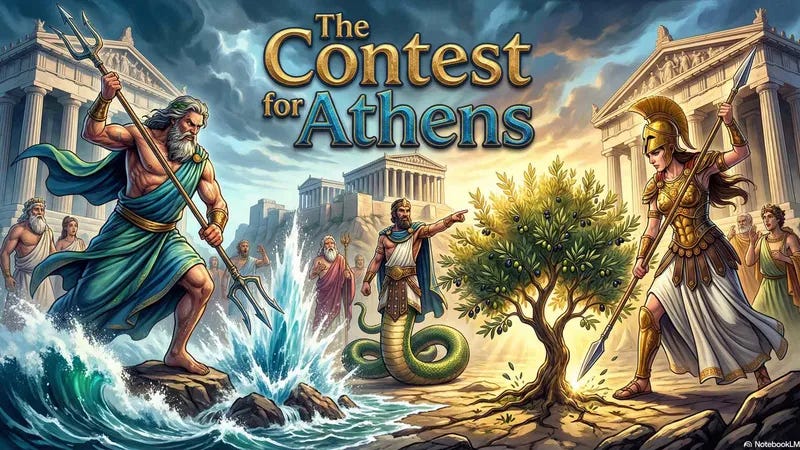
In the mythology of the founding of Athens, Cecrops held some kind of contest between Athena and Poseidon, and chose Athena as the winner, building her temple on the Acropolis. Poseidon, being angered by his unfair loss, took vengeance by flooding the land from Thessaly to the south Peloponnesus. We interpret that as the Attic version of the same flood as that of Dardanus. Thus we can narrow the date of the Dardanian flood to the reign of Cecrops between 1495 and 1445 BC.
The Birth of Krishna 3,162 Years Before the 40th Year of Akbar
Above we mentioned that we would expect historical and mythological sources to have noted both the low-water mark of the Ice Age ocean, as well as the return of the sea to its former level. The Hindu account of Krishna mentions both extremes. Early in the life of Krishna, he asked the sea to retreat to make room for his new capital city of Dwarka.
Krishna, who had already foreseen this, turned and addressed the ocean directly: “O ocean, if you have any respect for me, then withdraw thy form in the water extending over twelve yojanas. If you give room, this city, abounding in wealth and enjoyments, will be able to afford accommodation to my huge army.”
The ocean obeyed immediately — it offered up its bed, yielding twelve yojanas (roughly 85–100 miles) of land, on which Krishna built the city of Dvāravatī, also called Dwarka. The notion that the sea withdrew to provide land to build a city is consistent with the early part of the Ice Age as the sea level diminished by 135 meters, exposing the continental shelves as dry land.
At the end of Krishna’s life on earth, the sea returned and swallowed the city.
As the last survivors walked away from the city, the sea came: “After all the people had set out, the ocean… flooded Dwarka, which still teemed with wealth of every kind, with its waters. Whatever portion of the ground was passed over, ocean immediately flooded over with his waters.” The inhabitants, watching as the sea claimed street after street behind them, said simply: “Wonderful is the course of fate!”
A small city named Dwarka (Dvārakā) still exists today on the coast of Gujarat. In January 2001, a catastrophic magnitude 8.0 earthquake struck the Gujarat region, just a few kilometres from Dvārakā, killing over 20,000 people. In the aftermath of the earthquake and the disruption to the seabed it caused, the National Institute of Ocean Technology (NIOT) was conducting sonar surveys in the Gulf of Khambhat (about 30 km offshore Gujarat) and detected large geometric structures on the ocean floor at a depth of roughly 30–40 metres. Subsequent dredging brought up artefacts including pottery, beads, sculpture fragments, and pieces of wood. Carbon-dating of one wood sample reportedly returned a date of around 7,500–9,500 years ago, which caused an enormous sensation — the then-HRD minister Murli Manohar Joshi publicly claimed it proved India was the cradle of civilisation.
While the standard Hindu cosmology places the death of Krishna immediately before the Kali Yuga (3104 BC), Krishna in the Hindu theology made multiple appearances in history. Hamilton identified the last appearance of that deity as conforming to the birth year of Moses.
Hamilton was given a duration of 3,162 years from the birth of Krishna to the 40th year of the third Mughal Emperor, Akbar, by the Brahman sage, Goverdhana of Kashmir (Hamilton 1820, Vol 1, 127-129). As the 40th year of Akbar was AD 1595, that yields 1568 BC for the birth of Krishna.
Hamilton identified Krishna as the Hindu deification of Moses, born in 1571 BC according to Ussher’s chronology. Hamilton made two more conversion steps to convert Hindu lunar years into civil years, resulting in 1572 BC for the birth of Krishna, as compared to Ussher’s 1571 BC date for Moses. Hamilton viewed the birth year being only 1-3 years off as a strong confirmation of the identity of Krishnu as Moses (Hamilton 1820, Vol 1, 127-129).
As the city of Dwarka was swallowed by the sea in the year following the death of Krishna, Hamilton used the 120-year life of Moses from scripture to place the sinking of Dwarka in the year 1452 BC.
Hamilton also drew from a minority account in which the sun delayed setting by 12 hours in order to listen to a eulogy about the greatness of Krishnu. Hamilton identified that as a Hindu witness to Joshua’s long day.
…it is recorded in the life of Crishnu, that in the year in which he died*, the Sun delayed setting, to hear the pious ejaculations of Akroon, who descanted on the virtues of Crishnu, as he journeyed to Bindreben. And that on his arrival in safety, that planet went down; making a difference of about twelve hours. It is further recorded, that in the same day that Arjoon left the city, “ the agitated deep began to swell, and, rising higher and higher, overwhelmed the whole country of Dwarchu; so that they were obliged to flee with precipitation.
– (Hamilton 1820, Vol 2, 224, emphasis added)
The biblical account of Joshua’s Long Day states that the sun was delayed in setting by about a day (Joshua 10:13). The Hindu account says 12 hours. However, the Hindus used a unit of time called the Rāśi or Horā which was the same as the Babylonian double hour, equivalent to two modern hours. Therefore the Hindu account records the sun being delayed in setting by a full day, in agreement with Joshua.
We do not have to accept Hamilton’s Euhemerism that identifies Krishna as a deification of Moses. If we skip Hamilton’s conversion from lunar to civil years, we get 1568 BC for the birth of Krishna, whoever he was. If Krishna lived 100 to 120 years, which was the normal lifespan at that time in history according to the MT data, we arrive at a range between 1468 and 1448 BC for the sinking of Dwarka.
Given the similar description of the permanent loss of over 100 miles of land to the sea, and the fact that sea level is effectively the same over the entire world ocean, we may reasonably interpret this as the same event that drowned South Madura.
Neither of these events could have been local tsunamis, though the region is certainly prone to such disasters. While a tsunami suddenly floods over the land, the sea always returns to its normal level afterwards. In both the Dwarka and South Madura floods, hundreds of miles of territory were permanently lost to the sea. Furthermore, the account of the sinking of Madura says that the sea rose street by street giving time for the residents to escape with their household goods. This is more consistent with a relatively slow rising of sea level such as during the Ice Age meltdown phase, rather than a tsunami that destroys everything in its path, faster than a human can run away. The drowning of both cities is best explained as the rise of the ocean at the end of the Ice Age reclaiming the continental shelf. The sites of both successor cities today are adjacent to rather broad continental shelves.
Linking the sinking of Dwarka, the sinking of the Tamil Academy, and the Flood of Dardanus as the same sudden and permanent rise in the oceanic sea level, and using the narrower of the ranges, we may establish a range of 1453-1448 BC for the Flood of Dardanus and the drowning of Dwarka. However, the most accurate date of all comes from the identification of Joshua’s Long Day.
The account of the sinking of Dwarka records two events that could only have happened once in human history: First, if there was only a single Ice Age, then, the oceanic sea level can only have risen suddenly enough to permanently drown former coastlands on a large scale once in history. Second, Joshua’s Long Day was unique, and can be precisely dated by biblical chronology to 1450 BC.
Given the four witnesses to the unique event of the sudden rise of the sea to the present level, permanently drowning former cities, and the two witnesses to the unique occurrence of Joshua’s Long Day, we may confidently identify the Flood of Dwarka, the drowning of South Madura, and the Flood of Dardanus as the same event in history, the high water mark of the Ice Age meltdown, which occurred in the year of Joshua’s Conquest, 1450 BC, recorded as new Anchor Point #97.
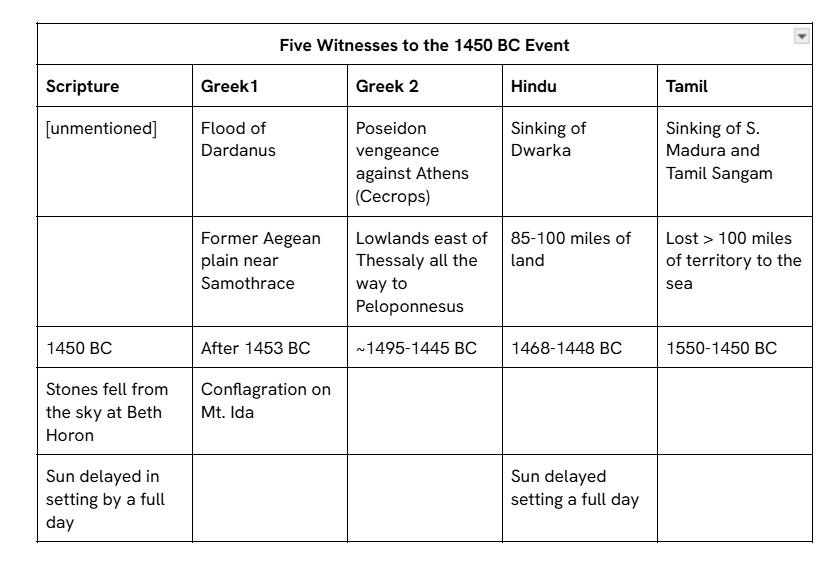
Conclusions - The Zanclean Flood Was Recorded in Human History in 1450 BC
Geologists refer to the event when the Atlantic overtopped Gibraltar and flooded the Mediteranean Sea as the Zanclean Flood. They date it to 6 million years ago. However, as we have shown above, the Zanclean Flood was the Flood of Dardanus. It occurred in human history, recorded by four different cultural witnesses in the year 1450 BC.
This was hands down the most informative masterpiece I have read since I joined Substack.
You touched on Dwarka which pulled me right in with my theory that it was Ice Age melting. Thank you for presenting this so well.
Ok… you have a new fan. I'm listening. I'll keep my eyes peeled. 👊
Is there any connection between any of these cataclysms that affected the Greek world and the phenomenon that reportedly destroyed Atlantis?