


The Temple of Baalbek, which the Romans called Heliopolis, the City of the Sun [god], has long mystified alternative historians. Baalbek is located in the Bekka Valley of Lebanon, below Mount Hermon. There is ample direct evidence that the Romans built the Temple of Jupiter at Baalbek from the time of Julius Caesar down to the reign of Marcus Aurelius Antoninus, who had been the high priest Elagabalus of a temple of the Homs, Syria region, which Vigato argues was Baalbek itself (Vigato 2026, 17). However, the Romans are not known to have built any other structures using such enormous 800-ton stones as those found in the trilithon at Baalbek, which is part of the pediment and enclosure wall.
Vigato cites Obrien to the effect that the platform at Baalbek uses Egyptian Royal Cubits as the unit of measure, while the Temple of Jupiter clearly uses Roman units:
“Now, the foundation platform on which the Trilithon rests is not only entirely different in style from other parts of the complex, but it has a different quantum of measurement”191.
– (Vigato 2026, 130)
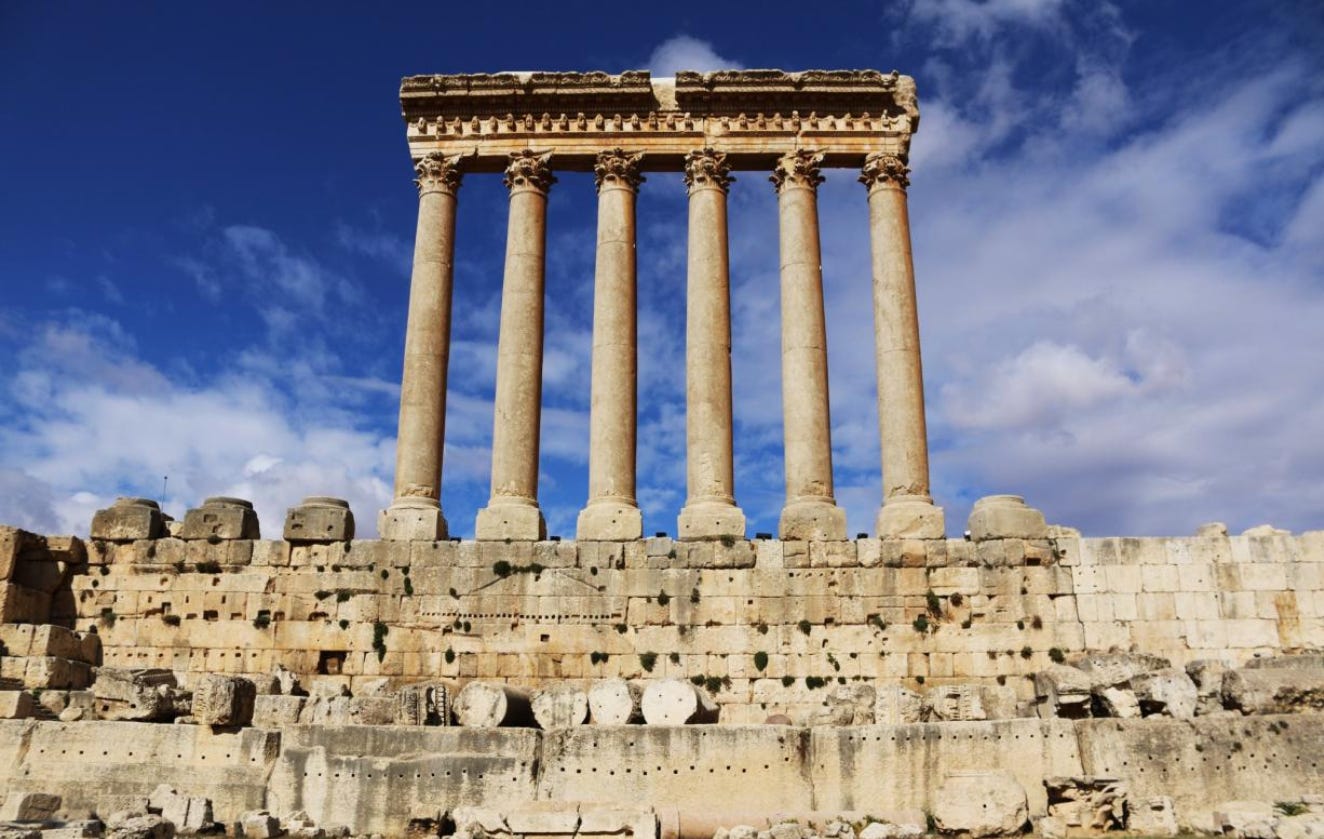
Velikovsky’s posthumously published essay, The Secret of Baalbek, argues that Solomon built Baalbek and that Jeroboam later used it for the northern golden calf temple (Velikovsky 1999). In light of our identification of Qatna as the site of Kirjath Dan, and the close similarities between the foundation enclosure stones of Baalbek and the stones of the Wailing Wall in Jerusalem, Velikovsky’s hypothesis looks increasingly plausible.
Scripture states that Jeroboam was foreman over the work crews of Ephraim and Manasseh (1 Kings 5:13-18; 1 Kings 11:28), which had built Solomon’s Temple, as well as the many store cities and other projects in Solomon’s kingdom. When Jeroboam led the secession of Israel from the House of David, he placed two golden calves in temples so the people would not travel to Jerusalem for the high holy feasts of Yahweh. The temple in the south was at Bethel and the northern temple was in Dan (1 Kings 12:28-30). If we view Dan in that instance as meaning the larger territory of the Danites controlled by the city of Qatna, then Baalbek was in the territory of Dan.
Given that Jeroboam’s goal for the Temples was to make them closer to the people so they would not travel to Jerusalem, it makes sense that he would utilize a pre-existing pagan worship site in the middle of the Bekka Valley rather than in Qatna itself at the very northern border of Israel.
Vigato (2026, 8-14) notes the tradition that Baalbek was originally a cult of El with strong connections to Egypt, and that the older megalithic outer wall and platform, which contains the trilithons, dates to the Middle Bronze Age. He notes that the toponym, “Mbk Nhrm,” meaning “source of the two rivers,” may refer to the location of Baalbek on the divide between the Litani and Orontes Rivers, whose sources were believed to be in a cavern beneath the temple.
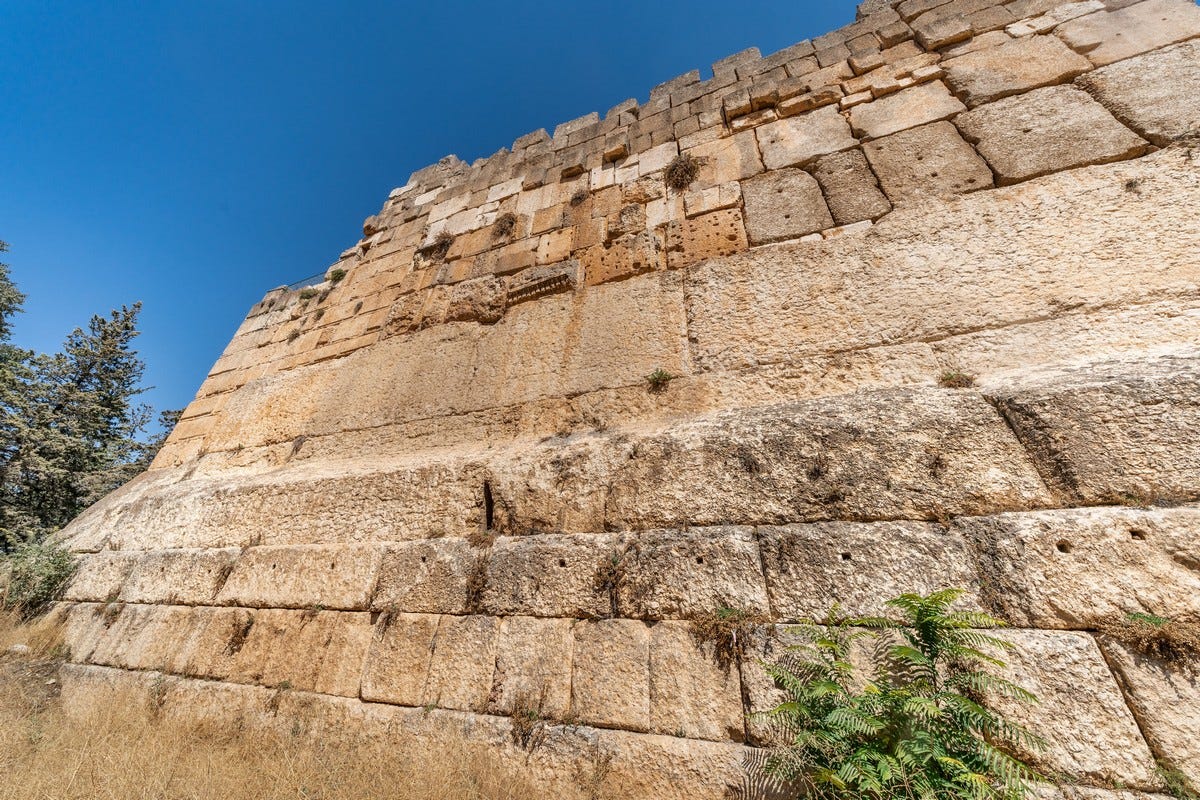
We might conclude that only Solomon had the experience, the technology, the manpower, and wealth to build the original megalithic temple at Baalbek with its mind-boggling trilithon stones, which the Romans later built on top of. Vigato notes that the stones of the Wailing Wall in Jerusalem are identical in style and construction method to the stones in the lower podium at Baalbek (Vigato 2026, 112-113).
Velikovsky cites Benjamin of Tudela as attributing the construction of Baalbek to Solomon:
12th‑century Jewish traveler Benjamin of Tudela: “This is the city which is mentioned in Scripture as Baalath in the vicinity of the Lebanon, which Solomon built for the daughter of Pharaoh.”
– (Velikovsky 1999)
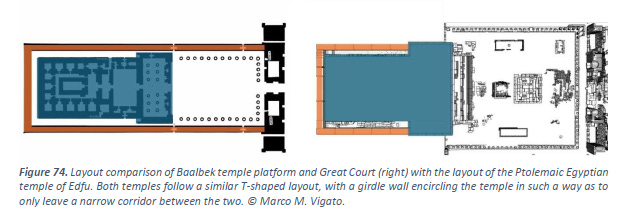
Supporting Tudela’s claim that Baalbek was an Egyptian-influenced temple, Vigato observes that the original platform and surrounding wall of Baalbek were very similar in style and layout to the Egyptian temple of Ptah at Edfu, which itself was based on much older Egyptian temples (Figure 11; Vigato 2026, 119).
Figure 11. Vigato’s comparison of Baabek to the Egyptian temple at Edfu.
Vigato notes that the original megalithic platform at Baalbek appears to have been interrupted during its construction and was either unfinished or completed with inferior material and craftsmanship. We suggest that Baalbek was one of the pagan high places built by Solomon for his foreign wives “when he was old” near the end of his reign (1 Kings 11:6-9). His death and the civil war that immediately followed probably interrupted the construction of the megalithic temple at Baalbek. When it was later finished under Jeroboam I, who was not nearly as wealthy as Solomon, lower quality materials were used.
Whether the sanctuary was originally built under Solomon at “Baalath” as some scholars suppose, or whether it was built by Jeroboam I after the death of Solomon, the Middle Bronze Age megalithic enclosure of the Temple of Baalbek fits the times and construction methods of the Temple of Solomon. As Jeroboam converted the Israelites from the worship of Yahweh to the worship of a solar deity, Baal, hybridized with Egyptian Apis worship as the golden calf called Simigi, Baalbek is a plausible match for the location of the temple that Jeroboam utilized in Dan for the northern golden calf. Velokovsky makes a thorough case for the golden calf at Baalbek in his essay (Velikovsky 1999).
References
Velikovsky, Immanuel. 1999. “The Secret of Baalbek: The Temple at Dan.” Velikovsky Archive. https://www.varchive.org/ce/baalbek/baalbek.htm .
Vigato, Marco. February 10, 2026. The Baalbek Enigma. (1.0). Zenodo. https://doi.org/10.5281/zenodo.18573529 .