


Anyone reading Genesis from start to finish might be a bit confused by the order of Genesis chapter 10 and 11. Genesis 10 is called the Table of Nations. It lists the descendants of Noah’s three sons: Japheth, Ham, and Shem, along with some territories, and concludes “These were the families of the sons of Noah, according to their generations, in their nations; and from these the nations were divided on the earth after the flood.” The certainly sounds like the colonization of the Earth had begun!
However, in the next chapter, we are told about the Babel rebellion.
Now the whole earth had one language and one speech. 2 And it came to pass, as they journeyed from the east, that they found a plain in the land of Shinar, and they dwelt there. 3 Then they said to one another, “Come, let us make bricks and bake them thoroughly.” They had brick for stone, and they had asphalt for mortar. 4 And they said, “Come, let us build ourselves a city, and a tower whose top is in the heavens; let us make a name for ourselves, lest we be scattered abroad over the face of the whole earth.”
The building of Babel was a rebellion against the division of the Earth in the days of Peleg.
To Eber were born two sons: the name of one was Peleg, for in his days the earth was divided; and his brother’s name was Joktan.
For decades creationists have speculated what the division of the Earth in the days of Peleg meant. Some have suggested that plate tectonics broke up the supercontinenent of Pangea into the present continents. Others have suggested that sea level rose at the end of the Ice Age, separating the continents by water.
However, Scripture is the best interpreter of Scripture. Eight centuries after the birth of Peleg, there was another division of the Eretz (earth or land) recorded by Joshua:
Then the men arose to go away; and Joshua charged those who went to survey the land, saying, “Go, walk through the land, survey it, and come back to me, that I may cast lots for you here before the Lord in Shiloh.” 9 So the men went, passed through the land, and wrote the survey in a book in seven parts by cities; and they came to Joshua at the camp in Shiloh. 10 Then Joshua cast lots for them in Shiloh before the Lord, and there Joshua divided the land to the children of Israel according to their divisions. — Joshua 18:8-10
The words division and land used in Joshua 18 are identical to the words used in Genesis 10 for the division of the earth in the days of Peleg. This suggests that Noah divided the world’s land into territories and gave them as inheritance to his sons and grandsons.
The composition of Jewish historical legends from the fourth century before Christ called the Book of Jubilees releates the details of this division of the Earth:
8.And in the sixth year thereof, she bare him son, and he called his name Peleg; for in the days when he was born the children of Noah began to divide the earth amongst themselves: for this reason he called his name Peleg.
9. And they divided (it) secretly amongst themselves, and told it to Noah.
10.And it came to pass in the beginning of the thirty-third jubilee that they divided the earth into three parts, for Shem and Ham and Japheth, according to the inheritance of each, in the first year in the first week, when one of us who had been sent, was with them.
11.And he called his sons, and they drew nigh to him, they and their children, and he divided the earth into the lots, which his three sons were to take in possession, and they reached forth their hands, and took the writing out of the bosom of Noah, their father.
— Book of Jubilees 8:8-11
Genesis 10 records 70 tribes from Noah, but it only assigns territories to three of them: Javan, Canaan, and Joktan. I propose that the map of the Prepottery Neolithic Tribes is the map of Genesis 10. Javan, Canaan, and Joktan were the first tribes to start moving out to their territories. But the Babel rebellion interrupted that movement. Thus the map of the Prepottery Neolithic below shows the Kingdom of Babel ruled by Cush and Nimrod from 2233 to 2191 BC.
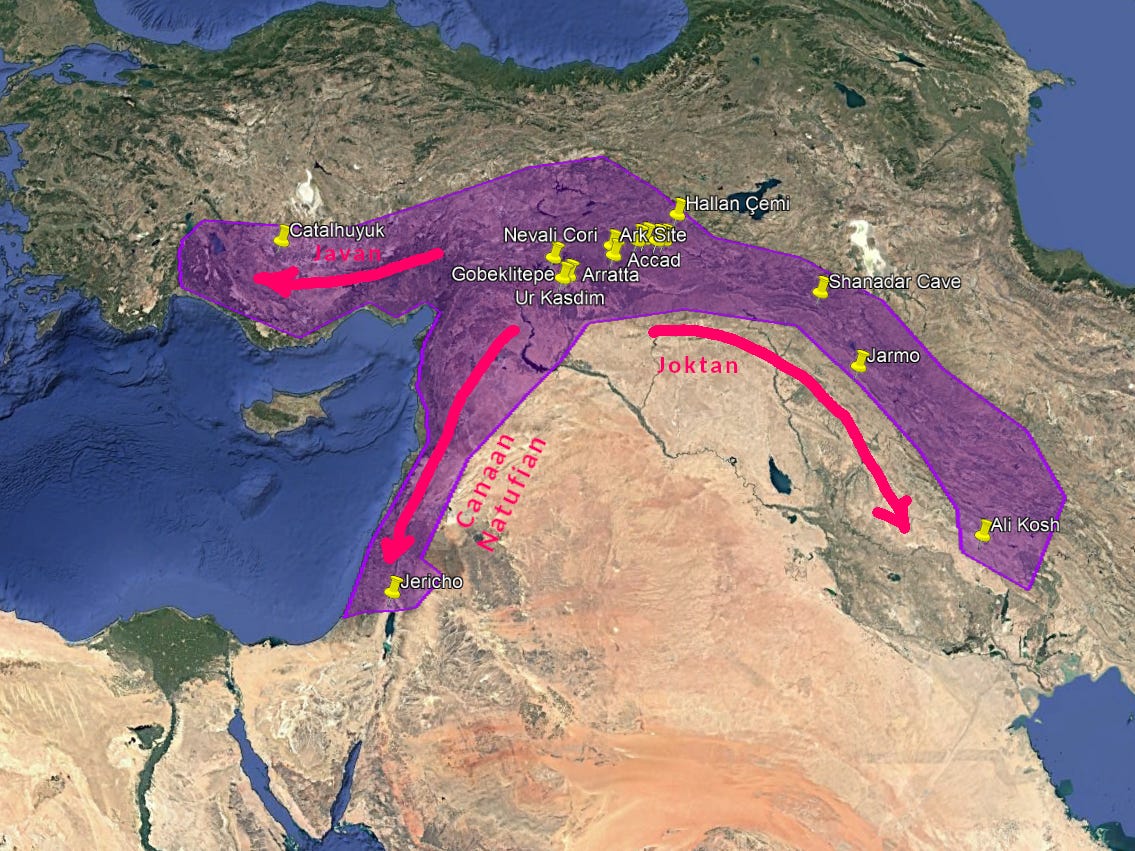
Based on the movement of these first three tribes described in Genesis 10, it has been assumed by Biblical commentators since great antiquity that Noah gave Europe to Japheth (father of Javan), Africa to Ham (father of Canaan), and Asia to Shem.
However, I would argue a modification to that view. I believe that Ham was given the quarter of the world that included most of Africa, and the southern half of South America. But Shem and Japheth were together given the other three quarters so that “Japheth dwelt in the tents of Shem.” By this I suggest that the remaining three quarters were divided into territories that alternated between the tribes of Shem and Japheth. Therefore we will find some Semitic tribes in Europe and the Americas, and we find Japhetic tribes in East Asia and the Americas as well.
Returning to the question at the start of this post, I propose that Genesis 10 and 11 are in chronological order. The movement to populate the world had started immediately after Noah divided the Earth as territorial allotments in the year Peleg was born, 2247 BC. Cush did not found Babel until 2233 BC. Thus the outward movement of the three first moving tribes, Javan, Canaan, and Joktan described in Genesis 10 started in the 14 years between the Division of the Earth and the founding of Babel in 2233 BC.
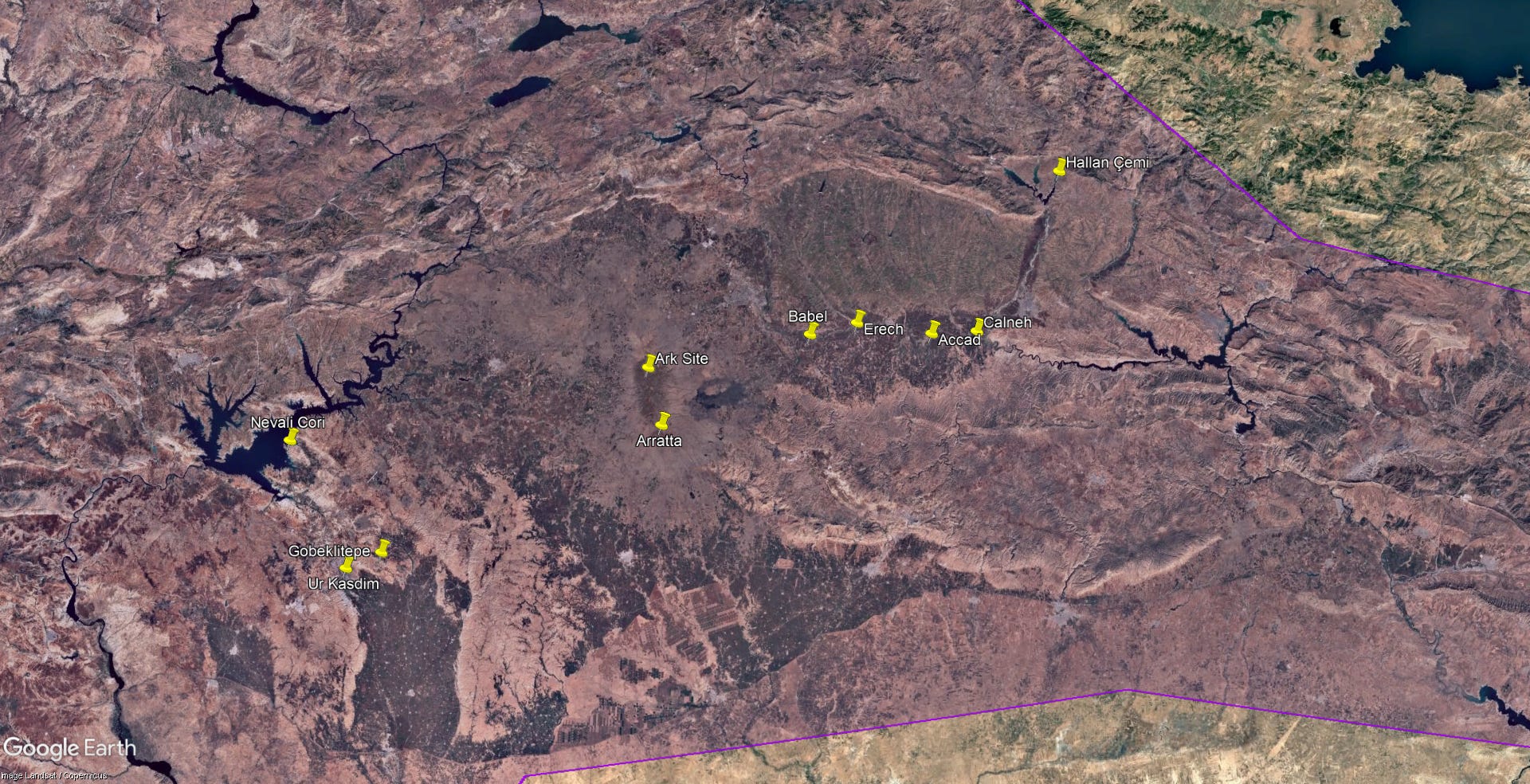
Finding the difficulties of migration to be daunting, Cush persuaded the people to stop the preparations for migrations to their land and build Babel instead (Figure 2).
I realize you stick with the MT, but thought it was still worth noting that Joshua 18:10 in the LXX does not include the "Joshua divided" reference. On the other hand, for interpretive purposes, Deut. 32:8 is certainly relevant. That verse credits "the Most-High" for dividing the nations. The LXX famously says this was done according to the number of God's angels.
"When the Most High divided the nations, when He scattered the sons of Adam, He set the boundaries of the nations by the number of God’s angels."